HY511 Peppermint Tetra Care Guide
A Complete Care Guide for Hyphessobrycon sp. "HY511"
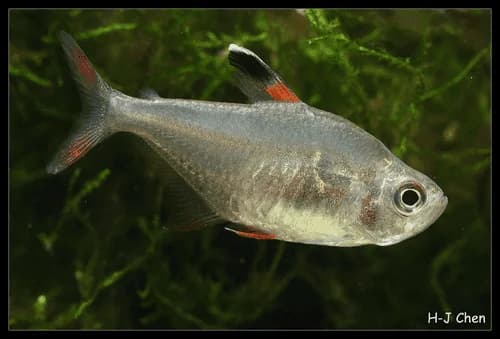
Introduction
The HY511 peppermint tetra is a trade name used in the aquarium hobby for a small, vivid tetra from South America whose formal scientific description is still being clarified. They display a vivid pattern combining a deep red body with iridescent silver-white highlights and distinctive dark and light banding or patterning that gives them a "peppermint" quality. Their small size and striking coloration have made them increasingly popular in the planted tank hobby.
Originating from rivers in South America (precise collection locality varies by trade source), HY511 peppermint tetras are found in soft, slightly acidic water typical of many South American tetra habitats.
HY511 peppermint tetra care is easy. They share the standard care requirements of most small Hyphessobrycon tetras: soft slightly acidic water, peaceful community tank mates, a school of 8 or more, and varied diet. Their vivid, contrasting coloration makes them stand out among small tetras.
Basic Overview
Common Misconceptions
"The trade name indicates an inferior or hybrid fish." HY511 is simply a trade designation used while the species awaits formal scientific description. These are naturally occurring fish from South American river systems, not hybrids or artificially created forms.
"They need exactly the same care as all Hyphessobrycon." Care is broadly similar to other Hyphessobrycon tetras, but soft, slightly acidic water produces significantly more vivid coloration in this species compared to neutral or harder water.
"A school of 4-5 is fine." Groups of 8-10 or more produce the most natural schooling behavior and the most striking collective color display.
Recommended Setup
- 20+ gallon planted tank
- Soft, slightly acidic water
- Dark substrate to maximize color contrast
- Dense planting with open swimming space
- Indian almond leaves or driftwood
- Gentle to moderate flow
Diet
HY511 peppermint tetras are omnivores that accept most small community foods:
- High-quality small flake or micro pellets
- Frozen baby brine shrimp
- Frozen daphnia
- Frozen micro worms
Feed twice daily in small amounts. A varied diet with live or frozen protein foods maintains the most vivid red and silver coloration.
Personality
HY511 peppermint tetras in a school are active, vivid fish with striking contrasting colors that make them immediately eye-catching in a planted tank. Their collective red and silver shimmer under warm-spectrum lighting is particularly attractive.
They are peaceful and compatible with most gentle community fish, dwarf shrimp, and nano catfish. In a dark-substrate planted setup, their contrast is maximized.
As more of these smaller, less commonly kept Hyphessobrycon species become available, they reward planted tank hobbyists with coloration that rivals or exceeds more familiar tetra species.
Water Parameters
HY511 peppermint tetras come from South American rivers with soft, slightly acidic conditions:
- pH: 5.5-7.0
- Hardness (gH): 2-10 dGH
- Temperature: 74-82 degrees F
- Ammonia and Nitrite: 0 ppm
- Nitrate: below 15 ppm
Here are some top tips to deal with unwanted parameters:
- Soft, slightly acidic water produces the most vivid coloration.
- Tannins from driftwood or Indian almond leaves replicate their natural habitat.
- Gentle flow and good plant cover.
- Weekly 20-25% water changes maintain stable parameters.