Horseface Loach Care Guide
A Complete Care Guide for Acantopsis dialuzona
Introduction
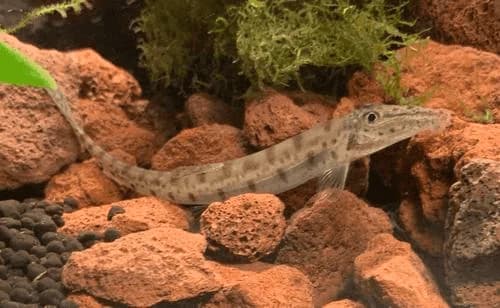
Acantopsis dialuzona, the horseface loach (or long-nose loach), is a distinctively shaped loach from Southeast Asia with an elongated snout that gives it an immediately recognizable "horse face" appearance. Their slender, elongated body with a pattern of irregular dark blotches on a sand-colored background provides excellent camouflage, as does their habit of burying themselves completely in sand with only the eyes visible.
Native to rivers and streams across Southeast Asia including the Mekong, Chao Phraya, and other river systems, horseface loaches inhabit sandy, shallow river sections with moderate current. They are obligate burrowers that spend most of their time submerged in sand.
Horseface loach care is easy to moderate. Their primary requirement is a deep fine sand substrate for their obligate burrowing behavior. Without appropriate substrate, they cannot bury themselves, which causes extreme, chronic stress. In appropriate setups they are long-lived, entertaining fish.
Basic Overview
Common Misconceptions
"They can be kept on gravel." Horseface loaches are obligate burrowers that must be able to bury themselves in fine sand. Gravel substrate prevents this completely and causes profound, ongoing stress. Fine sand at least 3-4 inches deep is essential.
"Not seeing them means they are dead." A horseface loach buried with only its eyes above the sand surface is a healthy, content fish exhibiting entirely normal behavior. The ability to do this is the reason they must have deep fine sand.
"They are social and need groups." Unlike many other loaches, horseface loaches can be kept singly or in small groups. They are not as strongly social as Botia loaches.
"Their unusual face shape indicates a genetic defect." The elongated, horse-like snout is entirely normal and natural to the species, used for sifting sand in search of invertebrates.
Recommended Setup
- 55+ gallon tank
- Deep fine sand substrate (4+ inches -- the most critical requirement)
- Sandy open areas for burrowing
- Smooth rocks and minimal decoration to maximize sand floor space
- Good filtration (protected intake due to fine sand)
- Moderate flow
- Tight-fitting lid (they can jump)
Diet
Horseface loaches are carnivores and invertebrate hunters that sift sand for food:
- Frozen bloodworms
- Frozen brine shrimp
- Small sinking pellets
- Frozen tubifex worms
- Live blackworms
Feed once daily, placing food directly on the sand surface near where they are buried. They will emerge to feed. Sifting sinking foods into the sand or placing food near their typical burrow location works well.
Personality
Horseface loaches are among the most unusual and entertaining loaches. A well-set-up horseface loach tank with deep, clean sand reveals a fish that is perpetually engaged in burying, emerging, sifting, and re-burying. The sight of a horseface loach face peering from the sand surface, with only the nose and eyes visible, is genuinely endearing.
Their elongated snout is used to sift mouthfuls of sand when hunting invertebrates -- a fascinating feeding behavior in appropriate setups. Their dramatic sand-diving behavior when startled is entertaining to observe.
Given their large adult size (7-8 inches) and need for a wide expanse of deep fine sand, a 55+ gallon tank dedicated to or significantly shared by horseface loaches makes an unusual, highly natural-looking biotope-style display.
Water Parameters
Horseface loaches come from the sandy rivers of Southeast Asia:
- pH: 6.5-7.5
- Hardness (gH): 5-15 dGH
- Temperature: 75-82 degrees F
- Ammonia and Nitrite: 0 ppm
- Nitrate: below 20 ppm
Here are some top tips to deal with unwanted parameters:
- Standard community tank water parameters are appropriate.
- Good filtration with sponge pre-filter to prevent fine sand entering the pump.
- Weekly 25% water changes maintain good conditions.
- Deep sand substrate is far more important than any specific water chemistry value.