Glass Catfish Care Guide
A Complete Care Guide for Kryptopterus vitreolus
Introduction
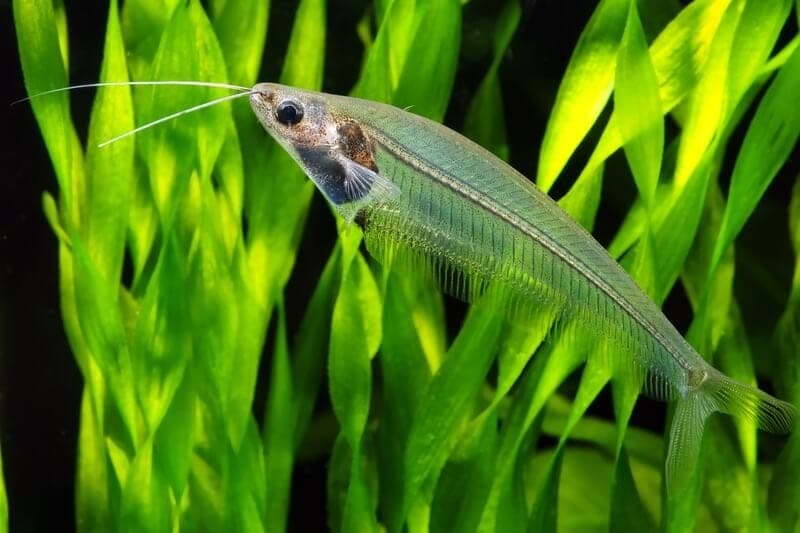
Kryptopterus vitreolus, the glass catfish, is one of the most unique-looking freshwater fish available. Their body is nearly completely transparent, with visible internal organs and a spine visible through the skin. They swim in a distinctive vertical-to-angled hovering posture, facing into gentle current, and must be kept in groups to remain active and healthy.
Native to Thailand and peninsular Malaysia, glass catfish inhabit slow to moderately flowing rivers and streams with clear to slightly tannin-stained water. They are mid-water fish that school in open water, unlike most catfish which are bottom-dwellers.
Glass catfish are peaceful, gentle community fish suitable for intermediate keepers. Their primary care requirements are water quality (they are more sensitive than many community fish), appropriate group size (minimum 6, preferably 8-10), and gentle flow.
Basic Overview
Common Misconceptions
"They can be kept as a single specimen or pair." Glass catfish kept alone or in pairs become stressed, refuse food, lose color, and often die within weeks. They require a group of at least 6 to feel secure, and 8-10 is much better. This is not optional for their welfare.
"They do not need special care." Glass catfish are noticeably more sensitive to water quality than standard community fish like tetras or barbs. They are intolerant of ammonia spikes, elevated nitrates, and major temperature swings. Consistent water quality is essential.
"They are bottom-dwelling catfish." Glass catfish are mid-water swimmers that hover in loose schools, often facing into gentle current. They do not rest on the substrate or behave like typical benthic catfish species.
"Strong current is fine." Glass catfish come from slow to moderately flowing water. Strong direct current causes stress and can prevent normal hovering behavior. Gentle, indirect flow is appropriate.
Recommended Setup
- 30+ gallon tank for a group of 6-8
- Dense planting along sides and back for security
- Open mid-water swimming space
- Gentle to moderate indirect flow
- Soft, diffused lighting
- Driftwood and leaf litter to add tannins and replicate natural habitat
- Good filtration with gentle output
Diet
Glass catfish are carnivores that prefer live and frozen meaty foods:
- Frozen bloodworms (primary preferred food)
- Frozen brine shrimp
- Frozen daphnia
- Live micro worms or grindal worms
- High-quality micro pellets (once trained)
Feed at mid-water level where the school hovers. Glass catfish often struggle to compete with faster-moving fish at the surface or bottom. Target feeding or feeding at the school's natural mid-water level ensures they receive adequate nutrition. They can be trained to accept micro pellets over time but live and frozen foods are strongly preferred initially.
Personality
Glass catfish are tranquil, graceful fish that add a unique visual element to any planted community tank. A group of 8-10 hovering in formation, occasionally drifting through open water before regrouping, has a calm, almost meditative quality.
Their transparent bodies catch light in striking ways: under warm-spectrum LEDs, internal organs and spines create a ghostly iridescent shimmer. Their coloration shifts with light angle, making them appear differently from different viewing positions.
In a secure, well-maintained group, glass catfish become increasingly bold and visible over time. New specimens are often shy, hiding near plants and avoiding open water. An established group in good conditions hovers confidently in the open, providing a constant mid-water display.
Stress and Health Indicators
Glass catfish are excellent indicators of tank conditions because their transparent bodies make physiological changes visible. A healthy glass catfish is clear to very slightly blue-tinted, hovers upright or at a slight angle, and actively joins the school.
Cloudy or milky appearance, clamped fins, hiding alone, or swimming erratically are all early warning signs of stress, disease, or water quality issues. Because they are visible, problems that would be hidden in opaque fish are often detectable early in glass catfish.
The most common health issue is ich (white spot), which appears as visible white cysts on the transparent skin. Glass catfish are sensitive to salt and many standard ich medications at full doses; use half doses and treat early. Increased temperature to 82-84 degrees F for 10 days (without medication) can resolve mild ich outbreaks in otherwise healthy fish.
Water Parameters
Glass catfish come from Southeast Asian rivers and prefer clean, slightly soft, warm water:
- pH: 6.5-7.5
- Hardness (gH): 5-12 dGH
- Temperature: 75-80 degrees F
- Ammonia and Nitrite: 0 ppm
- Nitrate: below 20 ppm
Here are some top tips to deal with unwanted parameters:
- Glass catfish are more sensitive to water quality than typical community fish. Nitrate above 20-25 ppm causes chronic stress. Weekly 25-30% water changes are important.
- Temperature stability is critical. Fluctuations of more than 2-3 degrees F in 24 hours cause immune suppression and disease susceptibility. Avoid placing the tank near drafts or temperature-variable locations.
- Neutral to slightly acidic, soft to moderately soft water produces the best health outcomes. In hard alkaline tap water, mixing with RO water to soften is beneficial.
- Avoid aggressive filtration outputs that create strong current. A gentle powerhead or spray bar directed at the back glass provides good water movement without stressing the school.