Flame Tetra Care Guide
A Complete Care Guide for Hyphessobrycon flammeus
Introduction
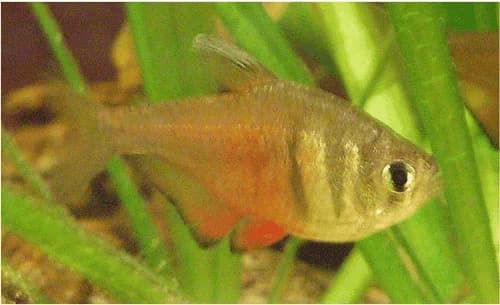
Hyphessobrycon flammeus, the flame tetra (also called the Von Rio tetra or red tetra), is a small, vivid Brazilian tetra with a distinctive gradient body: the front half is silver-blue with dark markings, and the rear half transitions to vivid flame-red coloration that extends into the anal and caudal fins. This two-tone fire-and-ice coloration gives the species its evocative "flame" common name.
Native to coastal rivers around Rio de Janeiro, Brazil, flame tetras inhabit slow-moving, soft, slightly acidic water with abundant vegetation. They are a historically significant aquarium fish that has been kept since the early days of the hobby.
Flame tetra care is easy and suitable for beginners. Their hardiness, peaceful temperament, and distinctive coloration make them reliable, attractive community schooling fish. They are among the most adaptable South American tetras, tolerating a wider range of water conditions than many.
Basic Overview
Common Misconceptions
"They are less colorful than neon tetras." The flame tetra's two-tone silver-blue and vivid red flame coloration is distinctive and attractive in its own right. In soft, slightly acidic water with good lighting, the red rear half has an intensity that competes with any small tetra.
"They need specific water chemistry." Flame tetras are among the most water-chemistry-adaptable of all small tetras. They tolerate neutral to slightly alkaline, moderately hard water in addition to their preferred soft slightly acidic conditions.
"A school of 4-5 is adequate." Groups of 8-10 or more produce natural schooling behavior and the most visually effective collective flame-red display.
Recommended Setup
- 15-20+ gallon planted tank for a school of 10
- Gentle to moderate flow
- Dark substrate enhances the red coloration
- Dense planting with open swimming space
- Standard community or soft slightly acidic water
Diet
Flame tetras are omnivores that accept most small community foods:
- High-quality small flake or micro pellets
- Frozen baby brine shrimp
- Frozen daphnia
- Frozen micro worms
Feed twice daily in small amounts. A varied diet with frozen protein foods maintains the most vivid red flame coloration. They are unfussy, reliable feeders.
Personality
Flame tetras are active, sociable schooling fish with a characteristic gentle energy. Their two-tone coloration -- particularly the transition from silver-blue to vivid flame-red -- creates a warm, attractive visual in a planted tank, especially in a large school where many fish display the flame pattern simultaneously.
They are peaceful with all community fish and safe with dwarf shrimp. Their hardiness and adaptability make them reliable, long-term community fish that reward beginners with consistent, low-maintenance success.
A classic planted community tank with a school of flame tetras has a warm, inviting aesthetic that has made this species one of the most enduring in the hobby since its introduction decades ago.
Water Parameters
Flame tetras are among the most water-chemistry-adaptable South American tetras:
- pH: 6.0-7.8 (adaptable)
- Hardness (gH): 3-18 dGH (adaptable)
- Temperature: 72-82 degrees F
- Ammonia and Nitrite: 0 ppm
- Nitrate: below 20 ppm
Here are some top tips to deal with unwanted parameters:
- Adaptability to a range of parameters is a defining characteristic of this species.
- Soft, slightly acidic water produces the most vivid red flame coloration.
- Standard tap water in most regions is adequate.
- Weekly 25% water changes are all that is needed.