Flagtail Prochilodus Care Guide
A Complete Care Guide for Semaprochilodus taeniurus
Introduction
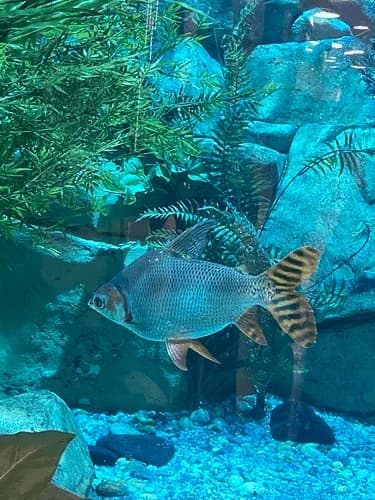
Semaprochilodus taeniurus, the flagtail prochilodus, is a large, striking South American characin recognized by its dramatically patterned caudal fin of alternating red-orange and dark bands -- the "flag" that gives it its common name. Their silver body with scaled iridescence and bold tail patterning makes them one of the most visually impressive large characins available.
Native to the Amazon and Orinoco river systems, flagtail prochilodus are migratory fish that travel long distances along river channels in large schools. They are detritivores and algae scrapers that feed on the organic film growing on submerged surfaces.
Flagtail prochilodus care is intermediate. Their large adult size (12-14 inches), preference for schools, plant-eating tendency, and need for a large, well-filtered aquarium make them suited to experienced fishkeepers with large setups. Their vivid flag-tail patterning and impressive schooling behavior reward the commitment.
Basic Overview
Common Misconceptions
"They are safe in planted tanks." Flagtail prochilodus will eat most aquatic plants and graze on algae covering surfaces. They are not suitable for planted tanks with soft-leaved plants. Robust species (java fern tied to wood) may be left alone.
"One fish is adequate." Prochilodus are schooling fish that show the most impressive behavior and the most vivid tail-flagging displays in groups of 4 or more. Solo fish are less active and less visually impressive.
"A 75-gallon tank is sufficient for adults." Adult flagtail prochilodus reach 12-14 inches and school actively. A minimum of 150 gallons for a group of 4-5 is required to prevent chronic stress from inadequate space.
"They cannot jump." Prochilodus are powerful jumpers. A secure, tight-fitting lid is essential.
Recommended Setup
- 150+ gallon tank for a school of 4-5
- Secure tight-fitting lid
- Large, open swimming space
- Strong filtration (heavy bioload from large fish)
- Large smooth rocks and driftwood for grazing
- No delicate plants
- Good flow and oxygenation
Diet
Flagtail prochilodus are detritivores and aufwuchs grazers in the wild:
- Algae wafers and spirulina-based foods
- Blanched vegetables: zucchini, cucumber, romaine
- Sinking herbivore pellets
- High-quality sinking pellets with some plant matter
- Occasional frozen foods (supplemental protein)
Feed once or twice daily. Their primary diet should be plant-based, reflecting their detritivore and algae-grazing habits. They will graze on algae growing in the tank between feeding sessions. Large blanched vegetables several times per week satisfy their plant-eating needs.
Personality
A school of flagtail prochilodus in a large aquarium is a spectacular sight. Their simultaneous tail flagging -- rapid, rhythmic caudal fin display showing off the red and dark banding -- creates a collective visual display that is unique among aquarium fish.
They are active, confident fish that patrol the entire tank, grazing on all surfaces. Their schooling cohesion strengthens as the group establishes itself, and the collective movement of a mature school is genuinely impressive in a large aquarium.
Their combination of large size, dramatic tail pattern, schooling behavior, and migratory energy makes them one of the most impressive large South American fish for very large aquarium setups.
Water Parameters
Flagtail prochilodus come from the Amazon and Orinoco river systems:
- pH: 6.0-7.5
- Hardness (gH): 5-15 dGH
- Temperature: 72-82 degrees F
- Ammonia and Nitrite: 0 ppm
- Nitrate: below 20 ppm
Here are some top tips to deal with unwanted parameters:
- Robust filtration is critical for large fish with high waste output. Oversized filtration is recommended.
- Good oxygenation through surface agitation.
- Standard Amazonian soft to moderately hard water parameters are appropriate.
- Weekly 30% water changes in large, well-stocked tanks.