Arulius Barb Care Guide
A Complete Care Guide for Dawkinsia arulius
Introduction
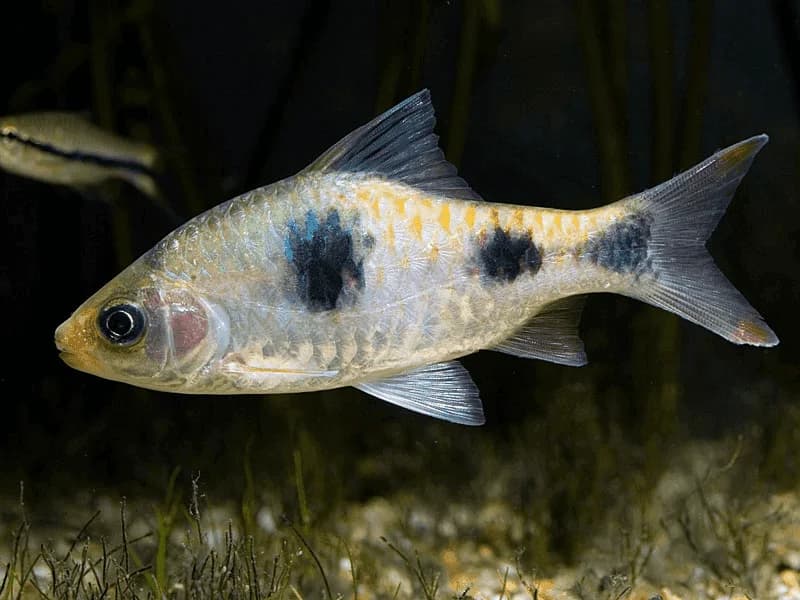
Dawkinsia arulius, the Arulius barb (also called the longfin barb), is a larger barb from the rivers of southern India. Males develop spectacular elongated extensions on the dorsal fin rays -- thread-like filaments that can reach considerable length in mature specimens -- giving the species its "longfin" common name. Their olive-green body with dark horizontal stripes and iridescent scales creates an attractive if understated display.
Native to fast-flowing hill streams and rivers in the southern Indian state of Tamil Nadu, Arulius barbs inhabit cool, clear, well-oxygenated water. Their native range has specific water chemistry that differs from typical tropical setups: slightly cooler, soft to moderately hard, and highly oxygenated.
Arulius barb care is easy to moderate. Their most important requirement is water temperature -- they prefer notably cooler conditions (66-75 degrees F) than most tropical fish, making them better suited to subtropical community tanks or species-appropriate setups. In good conditions, they are active, hardy, long-lived fish.
Basic Overview
Common Misconceptions
"They thrive at standard tropical temperatures." Arulius barbs come from cool hill streams and prefer 66-75 degrees F. Prolonged temperatures above 78 degrees F cause chronic stress, immune suppression, and shortened lifespan. This is the most common care error.
"The dorsal filaments are damaged fins." The long, thread-like filament extensions on mature male dorsal fins are a natural, healthy secondary sexual characteristic -- not fin damage or disease. Well-maintained males develop increasingly long filaments with age.
"A school of 3 is sufficient." Arulius barbs are active, social schooling fish that show the most natural behavior and the most impressive male dorsal displays in groups of 6 or more.
"They will nip fins." Arulius barbs are generally peaceful and not prone to fin-nipping, unlike many other barb species. In appropriate group sizes they make good community fish with other species of similar size.
Recommended Setup
- 55+ gallon tank for a school of 6
- Cooler water (66-75 degrees F) -- room-temperature tanks in many homes may be suitable without heating
- Moderate to strong flow and high oxygenation
- Open swimming space with some planted areas
- Smooth substrate
- Good filtration
Diet
Arulius barbs are omnivores that readily accept most aquarium foods:
- High-quality flake or pellets
- Frozen bloodworms
- Frozen brine shrimp
- Frozen daphnia
- Blanched vegetables: zucchini, spinach
Feed twice daily. Arulius barbs are enthusiastic, non-fussy feeders. A varied diet maintains the best health and the most vivid body coloration and longest dorsal filaments in males.
Personality
Arulius barbs in a school are active, energetic fish that constantly move through the open water of their tank. Their social interactions -- males displaying dorsal filaments at each other, the group schooling in loose formations -- are engaging to observe in a species-appropriate cooler-water setup.
The gradual development of the male dorsal filaments over months and years is one of the most rewarding visual progressions in barb-keeping. Young males have short extensions; mature males in excellent condition develop trailing filaments that can exceed the body depth.
Their tolerance of cooler temperatures makes them compatible with white cloud mountain minnows, hillstream loaches, and similar cool-water species that cannot share a tank with standard tropical fish.
Water Parameters
Arulius barbs come from the cool, well-oxygenated hill streams of southern India:
- pH: 6.0-7.5
- Hardness (gH): 5-15 dGH
- Temperature: 66-75 degrees F
- Ammonia and Nitrite: 0 ppm
- Nitrate: below 20 ppm
Here are some top tips to deal with unwanted parameters:
- Cool water is the single most critical parameter. A thermometer confirming temperatures stay below 76 degrees F is important.
- Strong oxygenation through surface agitation reflects their hill-stream origin.
- Standard tap water parameters in most regions are adequate. No special chemistry adjustments are needed beyond temperature management.
- Weekly 25% water changes maintain good conditions.