Eyespot Rasbora Care Guide
A Complete Care Guide for Brevibora dorsiocellata
Introduction
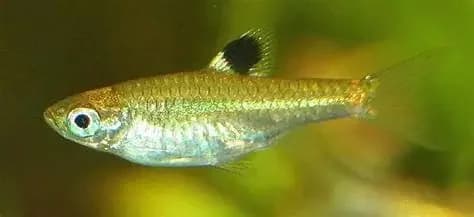
Brevibora dorsiocellata, the eyespot rasbora (also called the green-eye rasbora or ocellated rasbora), is a small, delicate rasbora from Southeast Asia. Their most distinctive feature is the prominent dark spot ringed with iridescent green at the base of the dorsal fin -- the "eyespot" that gives them their common name. Their slender, translucent silver body with green iridescent eye, pink-tinged fins, and iridescent scale sheen makes them distinctly attractive in planted nano tanks.
Native to slow-moving, blackwater streams and peat swamps in Malaysia and Sumatra, eyespot rasboras inhabit soft, acidic, tannin-stained water with abundant vegetation and leaf litter.
Eyespot rasbora care is easy. Their small size (1.5 inches), peaceful temperament, and attractive patterning make them suitable for nano planted tanks. Their preference for soft, acidic water is the primary care consideration.
Basic Overview
Common Misconceptions
"The eyespot is a parasite or disease." The iridescent green-ringed dark spot at the dorsal fin base is a permanent, normal feature of the species. It is the defining characteristic of B. dorsiocellata, not a pathology.
"They need standard neutral water." Eyespot rasboras develop the most vivid green iridescence and best health in soft, acidic, tannin-stained water. Hard or alkaline conditions suppress their natural coloration.
"A school of 5 is adequate." Groups of 10-15 or more produce natural schooling behavior and the most vivid collective display of their iridescent coloration.
Recommended Setup
- 10-15+ gallon nano planted tank
- Dense fine-leaved planting and floating plants
- Dark substrate
- Soft, acidic water
- Indian almond leaves or driftwood for tannins
- Very gentle sponge filtration
Diet
Eyespot rasboras are omnivores requiring small foods:
- Baby brine shrimp (live or frozen)
- Micro worms
- Daphnia
- Crushed nano flake
Feed twice daily in small amounts. Their small mouths require micro-sized foods. Baby brine shrimp produce the best coloration and condition.
Personality
Eyespot rasboras in a school create a shimmering, loosely cohesive group that moves through a planted nano tank with gentle grace. Their small size, translucent bodies with green iridescence, and distinctive dorsal eyespot make them visually interesting fish when observed closely.
They are completely peaceful with all tank mates, including dwarf shrimp and very small invertebrates. In a well-planted nano tank with dark substrate, warm-spectrum lighting, and Indian almond leaves, their green iridescence and eyespot are displayed to their full advantage.
A school of 15-20 eyespot rasboras in a 15-gallon blackwater nano tank is a beautiful, distinctive display that rewards close observation.
Water Parameters
Eyespot rasboras come from the soft, acidic blackwater peat swamps of Southeast Asia:
- pH: 5.5-7.0
- Hardness (gH): 1-8 dGH (soft water important)
- Temperature: 72-79 degrees F
- Ammonia and Nitrite: 0 ppm
- Nitrate: below 10 ppm
Here are some top tips to deal with unwanted parameters:
- Soft, acidic blackwater conditions produce the most vivid green iridescence.
- Indian almond leaves and driftwood provide natural tannins and biofilm.
- Sponge filtration is ideal -- very gentle current.
- Small weekly water changes of 10-15% maintain stability.