Brilliant Rasbora Care Guide
A Complete Care Guide for Rasbora borapetensis
Introduction
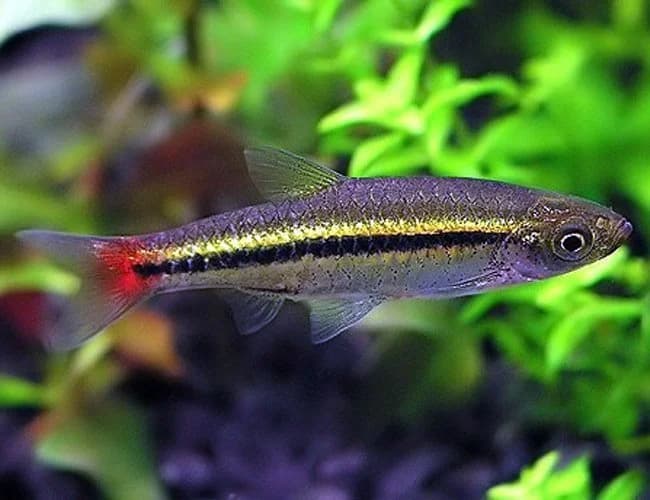
Rasbora borapetensis, the brilliant rasbora (also called the red-tailed rasbora or Bora Bora rasbora), is a slender, attractively marked rasbora from Southeast Asia. Their silver body is marked with a distinct black lateral stripe bordered by golden-yellow iridescence, and the caudal fin is strikingly red-orange, giving them a vivid accent color that is eye-catching in motion.
Native to rivers and streams in Thailand and Malaysia, brilliant rasboras inhabit a range of slow to moderate-flowing freshwater habitats with soft to moderately hard water. They are adaptable, hardy fish.
Brilliant rasbora care is easy and suitable for beginners. Their peaceful temperament, attractive coloration, and adaptability to a range of conditions make them excellent community schooling fish for planted or open aquariums.
Basic Overview
Common Misconceptions
"They are a dull or common fish." The red-orange caudal fin against the black-and-gold lateral stripe, especially visible in motion in a school of 15 or more, is genuinely vivid. The collective effect of a large school is more striking than individual fish suggest.
"A small group is adequate." Schools of 10 or more show the most natural, cohesive schooling behavior. Large groups reduce shyness and produce a more impressive visual display.
"They need specialized water." Brilliant rasboras are adaptable to a wide range of standard community tank parameters. They do not require the specific soft acidic water of some other rasbora species.
Recommended Setup
- 20+ gallon tank for a school of 10
- Planted or open community setup
- Moderate flow
- Good filtration
- Dark substrate to enhance the red and gold coloration
Diet
Brilliant rasboras are omnivores that accept most standard community foods:
- High-quality small flake or micro pellets
- Frozen baby brine shrimp
- Frozen daphnia
- Frozen bloodworms
Feed twice daily in small amounts. They are straightforward, non-fussy feeders. A varied diet with frozen protein foods maintains the most vivid red tail coloration.
Personality
Brilliant rasboras are active, sociable schooling fish that move through the water column in constant loose formations. Their red-orange caudal fin is especially visible when the school turns and catches the light simultaneously -- a pleasing visual effect in a well-lit planted tank.
They are completely peaceful with all tank mates, including dwarf shrimp and very small fish. Their adaptability and ease of care make them one of the most reliable choices for a beginning fishkeeper's first planted community tank.
In a school of 15-20 in a 30-gallon planted tank, their collective coloration and schooling behavior creates a dynamic, attractive display that belies their modest individual size.
Water Parameters
Brilliant rasboras come from the rivers of Thailand and Malaysia:
- pH: 6.0-7.5
- Hardness (gH): 3-15 dGH
- Temperature: 72-82 degrees F
- Ammonia and Nitrite: 0 ppm
- Nitrate: below 20 ppm
Here are some top tips to deal with unwanted parameters:
- Standard community tap water parameters are adequate. This is an adaptable species.
- Slightly soft, slightly acidic water produces the most vivid coloration.
- Weekly 25% water changes are sufficient.
- Good filtration with gentle to moderate flow.