Bumblebee Goby Care Guide
A Complete Care Guide for Brachygobius xanthozona
Introduction
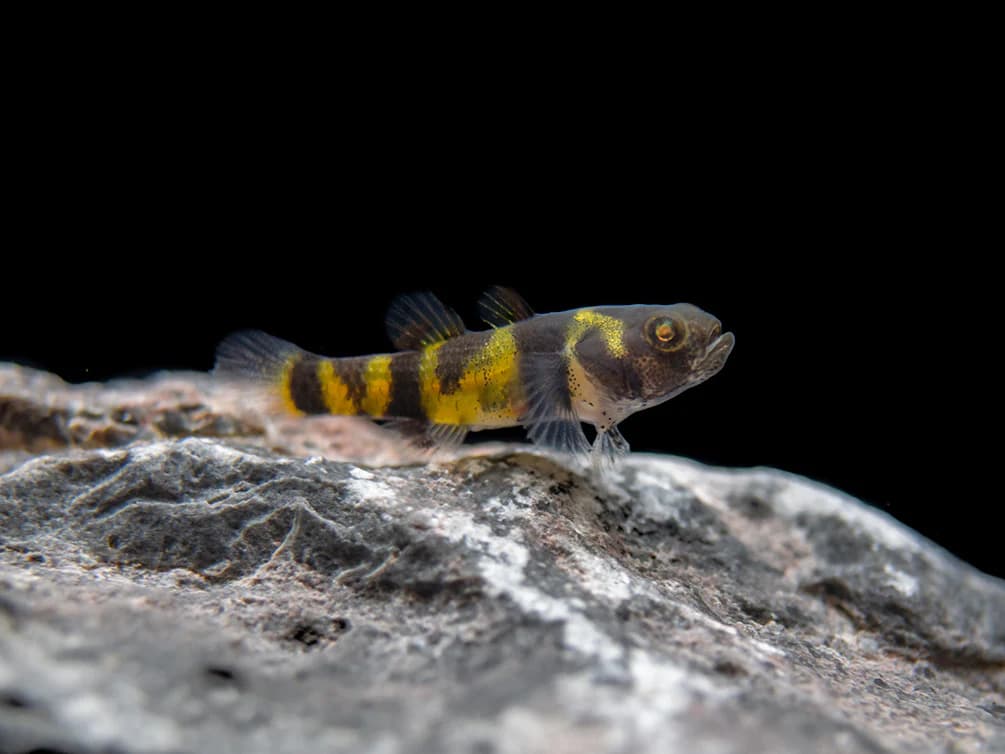
Brachygobius xanthozona, the bumblebee goby, is a tiny (1-1.5 inch) brackish water fish from Southeast Asia with vivid black and yellow banding that gives them their common name. They are fascinating, comical little fish with strong personalities that far exceed their small size.
Native to brackish estuaries, mangroves, and tidal rivers of Borneo, Sumatra, Thailand, and Java, bumblebee gobies require low to moderate salinity for long-term health. They are frequently sold in the freshwater section of fish stores, where they are misidentified as freshwater fish. Keeping them in purely freshwater shortens their lifespan.
Their care is intermediate due to the brackish requirement, their preference for live food, and the territorial behavior of males. In a species-specific or carefully chosen brackish community, they are highly entertaining and long-lived fish.
Basic Overview
Common Misconceptions
"They are freshwater fish." Bumblebee gobies are brackish water fish. While they survive short-term in freshwater, long-term freshwater keeping causes immune suppression and shortened lifespan. Specific gravity of 1.004-1.008 is appropriate.
"They will eat prepared foods readily." Bumblebee gobies have a strong preference for live food and are often reluctant to accept frozen or prepared foods initially. Patience and a transition period starting with live foods is necessary.
"Any small fish is a good tank mate." Bumblebee gobies are territorial and can bully very small, slow fish. They also cannot compete well with fast feeders. A species-specific tank or careful brackish community is best.
"They stay in groups peacefully." Males are territorial and will compete for cave territories. Provide more caves than there are males and ensure adequate space. Despite the sparring, injuries are rare.
Recommended Setup
- 15+ gallon brackish setup; 20 gallons allows a more stable colony
- Brackish water at specific gravity 1.004-1.008 using marine salt mix
- Fine sand substrate
- Multiple small caves: coconut shells, PVC elbows, clay pipes (one per fish minimum)
- Hardy brackish-tolerant plants: Java fern, anubias, Vallisneria (tolerate low salinity)
- Low to moderate flow
- A lid to prevent jumping
Diet
Bumblebee gobies are obligate carnivores with a strong live food preference:
- Live bloodworms (primary preferred food)
- Live or frozen brine shrimp
- Live daphnia
- Frozen bloodworms (transition to these from live over time)
- Live black worms
Feed once daily. Begin with live foods and gradually transition to frozen equivalents over weeks. Many individuals eventually accept frozen bloodworms readily. Avoid flake foods as a staple; they are nutritionally poor and largely ignored by bumblebee gobies.
Personality
Bumblebee gobies are boldly territorial little fish that each claim and defend a cave or crevice as their personal territory. Males engage in frequent face-offs: puffing up, spreading fins, and dancing at each other across territory borders. This posturing is entertaining and rarely escalates to injury.
Despite their boldness with each other, they are curious about their keeper and will often approach the glass to investigate. Their large eyes give them an expressive quality and they appear genuinely alert to activity outside the tank.
They are bottom dwellers that spend most of their time resting on surfaces, darting out to investigate potential food items, and patrolling their territory. Their movement is characteristically goby-like: quick darts punctuated by extended stillness.
Setting Up Brackish Water
Brackish water is created by mixing marine salt mix (not plain aquarium salt) with freshwater to achieve the target specific gravity. For bumblebee gobies, a specific gravity of 1.004-1.008 is appropriate. Use a refractometer for accurate measurement.
For a 15-gallon tank at 1.006, you need approximately 45-60 grams of marine salt mix. Always mix salt fully into water before adding to the tank. Never add salt crystals directly to a tank with fish.
Water evaporation increases salinity. Top off evaporation with fresh water only. Use salted water only for actual water changes. Weekly 15-20% water changes with matched-salinity water maintain stable conditions.
Water Parameters
Bumblebee gobies require brackish water matching their native tidal environment:
- Specific Gravity: 1.004-1.008 (use marine salt mix)
- pH: 7.5-8.5
- Hardness (gH): 10-20 dGH
- Temperature: 72-82 degrees F
- Ammonia and Nitrite: 0 ppm
- Nitrate: below 20 ppm
Here are some top tips to deal with unwanted parameters:
- Use a refractometer for accurate salinity measurement. Swing-arm hydrometers are less accurate and the difference matters for brackish fish health.
- Mature, fully cycled filtration is essential. The beneficial bacteria in a brackish tank are the same species as in freshwater and cycle the same way.
- Avoid copper-based medications in any brackish invertebrate-friendly setup.
- Consistent brackish conditions are more important than hitting a precise salinity. Keep the specific gravity stable within 0.002 of the target.