Banjo Catfish Care Guide
A Complete Care Guide for Bunocephalus coracoideus
Introduction
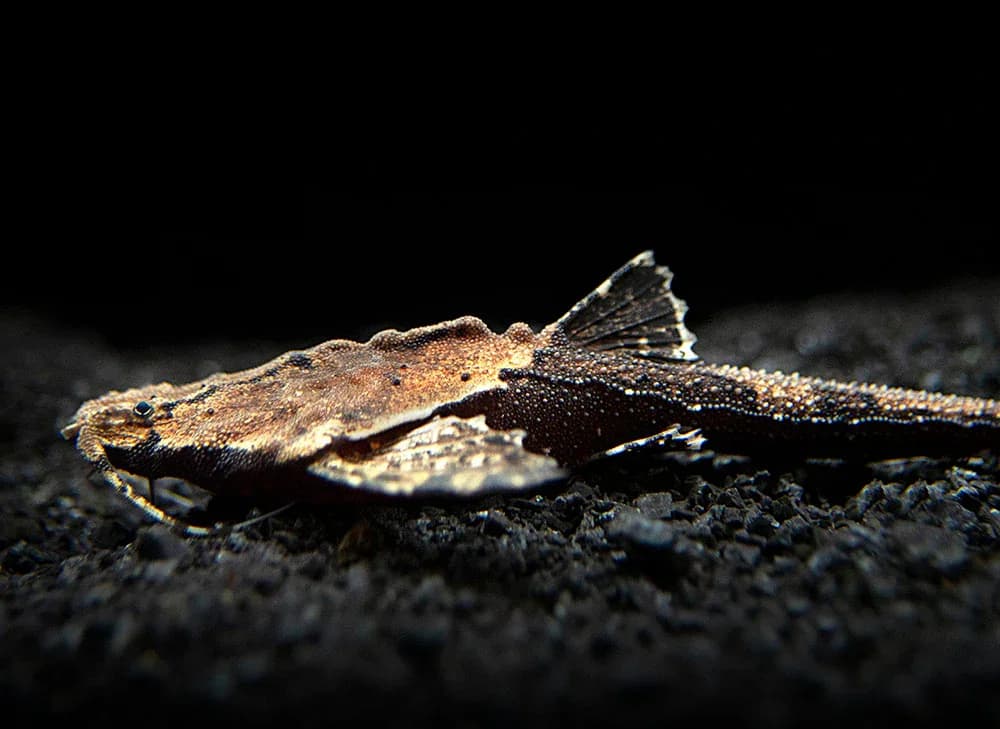
Bunocephalus coracoideus, the banjo catfish, is one of the most unusually shaped freshwater fish in the hobby. Their extremely flattened, broad head and narrow, elongated body give them a silhouette that unmistakably resembles the musical instrument that gives them their common name. Their mottled brown and grey coloration with textured, bumpy skin makes them nearly invisible against leaf litter and substrate.
Native to river basins across South America including the Amazon and Orinoco, banjo catfish inhabit shallow, slow-moving rivers and streams with sandy or muddy substrates, abundant leaf litter, and low flow. They are detritivores and carnivores that forage on the substrate and burrow into soft sediment.
Banjo catfish care is easy once their need for fine substrate and low competition for food is understood. They are extremely reclusive, spending most of their time buried in substrate or hidden under leaf litter. Their extraordinary camouflage and sedentary lifestyle make them an interesting if undemanding specialist species.
Basic Overview
Common Misconceptions
"They are active, visible catfish." Banjo catfish are among the most reclusive fish in the hobby. They spend most of their time buried in sand or hidden under leaf litter and may be invisible for days or weeks at a time. This is normal behavior, not illness.
"They compete normally for food." Banjo catfish are passive feeders that will not compete with active community fish. In a mixed community tank without target feeding, they slowly starve despite appearing healthy. Specific nighttime target feeding is required.
"They need lots of space." Banjo catfish are sedentary and do not require large tanks. A 20-gallon aquarium with deep, fine sand and leaf litter is entirely appropriate for a pair or small group.
"Their rough, bumpy skin indicates disease." The warty, tubercle-covered skin is entirely natural to this species. It contributes to their remarkable camouflage and is not a sign of any disease.
Recommended Setup
- 20+ gallon tank
- Deep fine sand substrate (3+ inches) for burrowing
- Abundant leaf litter (Indian almond or dried oak leaves) for hiding
- Very gentle flow
- Dim lighting
- Peaceful, non-competitive tank mates
- Filter intake protection (fine mesh or sponge pre-filter)
Diet
Banjo catfish are carnivores that feed on small invertebrates and detritus:
- Frozen bloodworms (placed directly on sand near hiding spots)
- Frozen tubifex worms
- Small sinking pellets placed at night
- Frozen brine shrimp
- Live blackworms (excellent for stimulating feeding)
Feed after lights out, placing food directly near their hiding spots. Banjo catfish will not come out to compete with other fish. Target feeding at night with a red flashlight to observe feeding behavior is the reliable approach. They eat small amounts slowly.
Personality
Banjo catfish are the embodiment of patience and concealment. A well-set-up banjo catfish tank with deep sand and leaf litter will challenge even the keeper to locate the fish during the day. Their camouflage is extraordinary -- a motionless banjo catfish on sand against leaf litter is essentially invisible.
At night, they emerge to forage along the substrate and through the leaf litter. Observing them with dim red lighting reveals active, purposeful movement that is markedly different from their daytime stillness.
Their unusual body shape, mysterious lifestyle, and extraordinary camouflage make them fascinating specialty fish for aquarists who appreciate the unusual and do not require constant visible activity from their fish.
Water Parameters
Banjo catfish come from the slow-moving, warm rivers and streams of South America:
- pH: 6.0-7.5
- Hardness (gH): 2-15 dGH
- Temperature: 72-79 degrees F
- Ammonia and Nitrite: 0 ppm
- Nitrate: below 20 ppm
Here are some top tips to deal with unwanted parameters:
- Gentle flow and soft substrate are more important than specific water chemistry values.
- Indian almond leaves release tannins that create a natural, low-pH, tannin-stained environment close to their native habitat.
- Weekly 20-25% water changes maintain good conditions.
- Avoid copper-based medications.