Banded Leporinus Care Guide
A Complete Care Guide for Leporinus fasciatus
Introduction
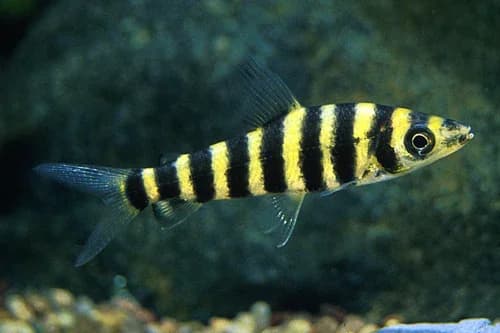
Leporinus fasciatus, the banded leporinus, is a striking South American characin with a dramatically patterned body of alternating black and yellow horizontal bands. Their torpedo-shaped body, bold patterning, and active swimming make them impressive display fish for large aquariums. Their name comes from the Latin for "hare," referring to the large, rabbit-like front teeth used for biting off plant material.
Native to rivers throughout much of South America, including the Amazon, Orinoco, and Parana basins, banded leporinus inhabit fast-flowing rivers and flooded forest areas. They are active swimmers that require significant space.
Banded leporinus care is intermediate. Their large adult size (10-12 inches), tendency to nip fins and eat plants, and need for a large tank make them unsuitable for typical community setups. In a large tank with robust, similarly sized tank mates, they are spectacular, long-lived fish.
Basic Overview
Common Misconceptions
"They are safe in a planted community." Banded leporinus will eat most aquatic plants and nip the fins of slower, longer-finned fish. They are not suitable for planted tanks with delicate species.
"A 55-gallon tank is fine for adults." Adult banded leporinus reach 10-12 inches and are fast, active swimmers. A minimum of 125 gallons for adult fish is required to prevent chronic stress from inadequate space.
"They are schooling fish." Adult banded leporinus are not reliably peaceful with each other and can become territorial. They are best kept singly or in very large groups (6+) in very large tanks where established hierarchies reduce conflict.
"They do not jump." Banded leporinus are powerful jumpers. A tight-fitting lid is essential. Losses to jumping are common in tanks with any gaps.
Recommended Setup
- 125+ gallon tank for adult fish
- Secure, tight-fitting lid
- No or only robust, inedible plants (java fern, anubias)
- Strong filtration with good flow
- Large open swimming space
- Robust tank mates: large cichlids, large catfish, large barbs
Diet
Banded leporinus are omnivores with a strong herbivorous component:
- High-quality cichlid or large-fish pellets
- Blanched vegetables: zucchini, cucumber, romaine lettuce
- Frozen bloodworms
- Frozen brine shrimp
- Fresh or frozen peas (shelled)
Feed once or twice daily. Banded leporinus have a strong appetite for plant matter. Regular provision of blanched vegetables is important to reduce plant-nipping at aquarium plants and satisfy their nutritional needs. They readily accept all large sinking foods.
Personality
Banded leporinus are bold, fast, and visually commanding fish. Their jet-black and bright yellow banding pattern moving through a large aquarium is striking. They are confident, active swimmers that rarely hide and spend most of their time in the open water column.
Their personality is curious and interactive -- they investigate anything new added to the tank and respond quickly to feeding. However, their fin-nipping tendency means they are not suitable companions for any fish with flowing or delicate fins.
In large South American biotope setups or large mixed cichlid tanks, their size, bold patterning, and active behavior make them excellent focal fish.
Water Parameters
Banded leporinus come from the rivers of South America and adapt to a range of conditions:
- pH: 6.0-7.5
- Hardness (gH): 5-15 dGH
- Temperature: 72-82 degrees F
- Ammonia and Nitrite: 0 ppm
- Nitrate: below 25 ppm
Here are some top tips to deal with unwanted parameters:
- Good filtration is critical due to the high waste output of large, active fish. Oversized filtration is recommended.
- Standard South American water parameters work well. They are adaptable.
- Weekly 30% water changes maintain good conditions in large, well-stocked tanks.
- Strong flow and good oxygenation reflect their river habitat.