Assassin Snail Care Guide
A Complete Care Guide for Clea helena
Introduction
Clea helena, the assassin snail, is a carnivorous freshwater snail from Southeast Asia that has become an invaluable tool for aquarists struggling with pest snail infestations. Unlike most aquarium snails, assassin snails actively hunt and eat other snails, making them a biological control method for bladder snails, ramshorn snails, and Malaysian trumpet snails.
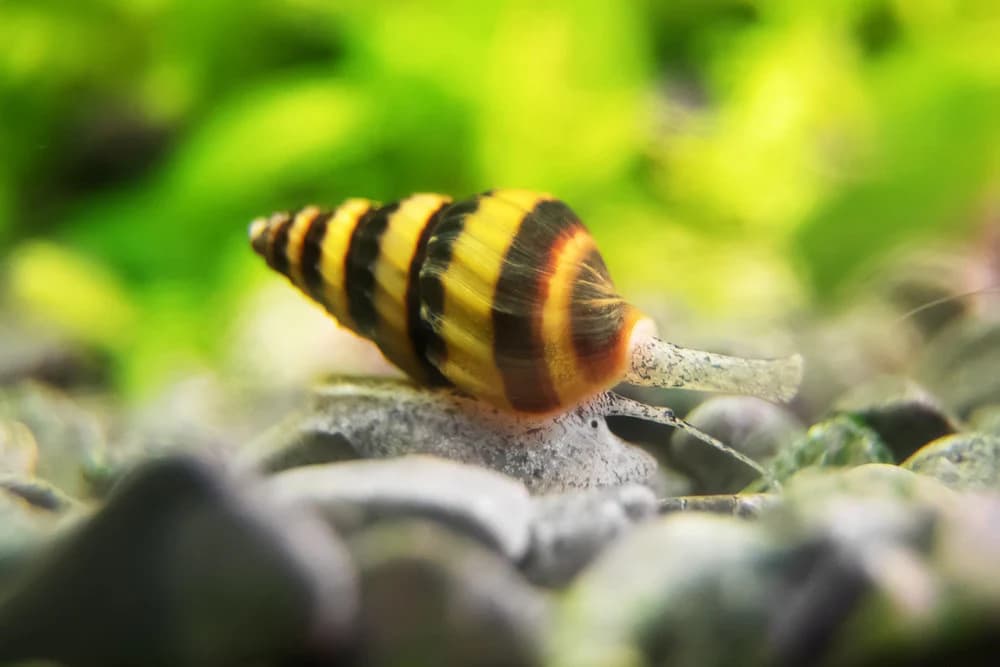
Native to the flowing rivers and still lakes of Thailand, Malaysia, and Indonesia, assassin snails have a distinctive yellow and dark brown banded conical shell that makes them visually appealing as well as practically useful. They grow to about 1 inch and are long-lived invertebrates that can breed in freshwater.
Assassin snails have become a staple recommendation in the hobby for snail control. Their carnivorous nature, attractive appearance, and ease of care make them one of the more interesting invertebrates available.
Basic Overview
Common Misconceptions
"Assassin snails will eat all my snails immediately." Assassin snails are effective but not instant. A small colony will steadily reduce a pest snail population over weeks to months. They are not a fast solution but a sustainable long-term control method.
"They will eat my large snails (nerites, mystery snails)." Assassin snails primarily target smaller snails they can physically overpower. Healthy adult nerite and mystery snails are generally safe. Assassins may target sick, dying, or very small individuals of larger species.
"They will not breed in freshwater." They will. A male-female pair will produce capsules containing single eggs attached to surfaces. The population grows slowly, which is generally manageable, but they do breed.
"They do not need feeding if snails are scarce." When snail prey runs out, assassin snails need supplemental feeding. They will accept sinking meaty foods and should not be starved after eliminating the snail population.
Recommended Setup
- 10+ gallon established, cycled tank
- Fine sand or smooth gravel substrate (they burrow to ambush prey)
- A population of pest snails as initial food source
- Hiding places: leaf litter, driftwood, rocks
- Moderate filtration; cover the filter intake to prevent snails from being sucked in
- Stable water parameters; avoid copper in any form
- A lid; they can crawl out through gaps
Diet
Assassin snails are carnivores that primarily hunt other snails in the wild and in the aquarium. When prey snails are scarce:
- Other snails (bladder snails, ramshorn snails, Malaysian trumpet snails)
- Sinking meaty foods: shrimp pellets, small pieces of frozen bloodworm
- Snail-specific sinking foods
- Leftover fish food that sinks to the substrate
- Frozen or freeze-dried bloodworms placed near their resting spots
When a pest snail population is eliminated, supplement 2–3 times per week with sinking meaty foods. Assassin snails are slow eaters; leave food near them rather than relying on them to find it across the tank. Maintaining a small culture of bladder snails in a separate container provides a steady natural food supply.
Personality
Assassin snails are active and interesting invertebrates to observe once you understand their behavior. They move more quickly and purposefully than most snails, particularly when hunting. Watching an assassin snail locate a bladder snail, extend its proboscis, and begin feeding is an oddly compelling spectacle.
They are burrowers that spend time partially buried in substrate, ambushing prey that wanders over them. This hunting strategy is different from the active pursuit behavior, and the two approaches together make them more effective hunters than their slow movement might suggest.
Multiple assassin snails can be kept together without conflict. They do not exhibit cannibalism (except possibly toward very small juveniles in a population under food pressure) and ignore each other otherwise.
Breeding and Population Management
Assassin snails breed slowly. A pair will produce egg capsules (each containing a single egg) attached to substrate, glass, or decorations. The eggs take 4–8 weeks to hatch; juveniles are tiny and burrow immediately upon hatching. Population growth is slow enough that it rarely becomes a problem.
If you want to maintain a population for ongoing snail control, keep 3–6 assassin snails in a tank and maintain a small pest snail food source. If you only want to eliminate a one-time infestation, 6–10 assassin snails in a 20-gallon tank will work through the population efficiently over 2–3 months.
After the pest snail population is controlled, you can rehome excess assassin snails to other fishkeepers dealing with snail problems, sell them back to local fish stores, or maintain them on supplemental feeding.
Water Parameters
Assassin snails come from a range of freshwater habitats in Southeast Asia and are quite adaptable:
- pH: 7.0–8.0 (slightly alkaline preferred for shell health)
- Hardness (gH): 8–15 dGH (moderate to hard; calcium for shell health)
- Temperature: 65–80°F
- Ammonia and Nitrite: 0 ppm
- Nitrate: below 20 ppm
Here are some top tips to deal with unwanted parameters:
- Adequate calcium (GH 8+) is important for shell health. In soft water, add a small piece of cuttlebone or crushed coral in the filter to raise calcium levels.
- Never use copper-based medications in a tank with assassin snails or any invertebrates. Even trace copper is lethal to all mollusks.
- Weekly 20–25% water changes maintain water quality. Assassin snails are hardier than shrimp but still need clean, stable conditions.
- Avoid very soft or acidic water. Shell erosion from low calcium combined with acidic conditions degrades their shells over time and shortens their lifespan.