Synodontis Angelicus Catfish Care Guide
A Complete Care Guide for Synodontis angelicus
Introduction
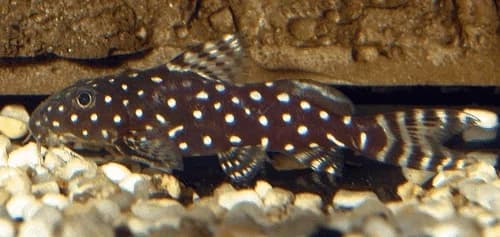
Synodontis angelicus, the angelicus catfish (or polka dot synodontis), is one of the most strikingly patterned Synodontis catfish from Central Africa. Their jet-black to dark purple body is densely covered with vivid white to yellow spots of varying sizes, creating an extraordinary constellation-like pattern. The spots are most numerous in juveniles and may become more irregular and less dense in very large adults.
Native to the Congo River basin in the Democratic Republic of Congo and Cameroon, S. angelicus inhabits fast-flowing, rocky sections of the river with well-oxygenated water. They are one of the larger and more dramatically colored members of the Synodontis genus.
Synodontis angelicus care is intermediate. Their large adult size (8-10 inches), need for good water quality, omnivore diet, and typically high cost (they are one of the more expensive Synodontis) make them suited to dedicated catfish and cichlid keepers. Their extraordinary appearance rewards the commitment.
Basic Overview
Common Misconceptions
"The spots fade with age." In well-maintained S. angelicus, the spot pattern evolves with age but does not simply fade. Large adults may have larger, fewer, more irregular spots rather than the dense constellation of juveniles. This pattern change is normal.
"They are safe in small tanks." At 8-10 inches as adults, S. angelicus require 75+ gallon tanks. Their large adult size surprises many first-time keepers who purchase them as attractively spotted juveniles.
"Multiple S. angelicus will always fight." While territorial with conspecifics, S. angelicus can be kept in groups in sufficiently large tanks (125+ gallons) with multiple hiding territories. Aggression is primarily territorial, not constant.
Recommended Setup
- 75+ gallon tank
- Large caves (essential)
- Smooth rocks and driftwood
- Good filtration and oxygenation
- Moderate to strong flow
- Dim to moderate lighting
Diet
Synodontis angelicus are omnivores that accept a wide range of sinking foods:
- Sinking pellets as primary staple
- Frozen bloodworms
- Frozen brine shrimp
- Blanched vegetables
- Algae wafers
Feed once daily in the evening. S. angelicus are reliable, non-fussy feeders once established. A varied diet maintains good health and the most vivid spot pattern.
Personality
Synodontis angelicus are bold, assertive catfish with an unmistakable presence. Their jet-black body covered in vivid white spots is extraordinary under aquarium lighting -- one of the most dramatically patterned freshwater fish available. Despite their mostly nocturnal nature, they often emerge in the evening and can be viewed actively in a well-set-up tank.
They develop individual personalities over time, recognizing their keeper and emerging earlier as they become comfortable in their environment. Their long lifespan (10-20+ years in ideal conditions) makes them remarkable long-term companion fish.
In a large Congo-themed setup with S. angelicus as a centerpiece catfish alongside Congo tetras, butterfly fish (Pantodon), and other Congo basin species, they represent one of the most impressive freshwater displays available.
Water Parameters
Synodontis angelicus come from the fast, well-oxygenated Congo River basin:
- pH: 6.5-7.5
- Hardness (gH): 5-15 dGH
- Temperature: 75-82 degrees F
- Ammonia and Nitrite: 0 ppm
- Nitrate: below 20 ppm
Here are some top tips to deal with unwanted parameters:
- Good filtration and regular water changes are important for long-lived large catfish.
- Strong oxygenation through surface agitation.
- Standard tropical water parameters are appropriate.
- Weekly 25-30% water changes in well-stocked tanks.