Red Fin Borleyi Cichlid Care Guide
A Complete Care Guide for Copadichromis borleyi
Introduction
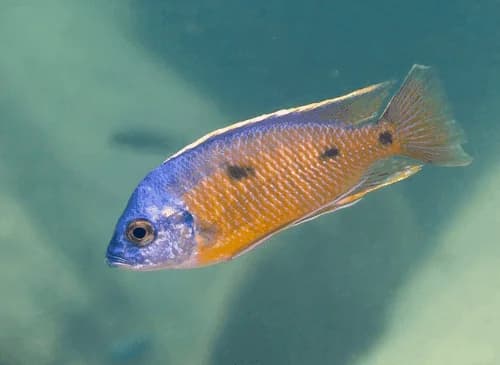
Copadichromis borleyi, the red fin Borleyi cichlid (also called Kadango red fin), is a large, spectacular Lake Malawi haplochromine cichlid. Males display a deep blue body with a contrasting vivid orange-red caudal fin and often an orange-red to deep red posterior body -- a color combination that creates a dramatic two-tone display. Their large size, vivid color, and open-water swimming behavior make them impressive display fish in large Malawi setups.
Endemic to Lake Malawi in East Africa, C. borleyi inhabits the open water and transitional sandy-rocky zones of the lake, feeding on plankton and invertebrates in midwater. Unlike mbuna cichlids, they are "utaka" cichlids -- open-water swimming species rather than rock-dwelling territorial scrapers.
Red fin Borleyi care is intermediate. Their large adult size (8-10 inches), open-water swimming preference, and Lake Malawi water requirements make them suited to large, experienced Malawi cichlid setups. Their dramatic coloration and active display behavior reward the commitment.
Basic Overview
Common Misconceptions
"They are the same as mbuna cichlids." C. borleyi is a utaka cichlid -- an open-water species very different from territorial mbuna. They require significantly more open swimming space, eat a more protein-rich diet, and are generally less aggressively territorial.
"A 55-gallon tank is sufficient." Adult male C. borleyi reach 8-10 inches and are active open-water swimmers. A minimum of 125 gallons is required to provide adequate space and allow appropriate male territorial behavior.
"They eat spirulina foods like mbuna." Red fin Borleyi are invertebrate feeders in the wild. They require higher protein in their diet than mbuna. Quality cichlid pellets with good protein content are appropriate; strict herbivore foods are insufficient.
Recommended Setup
- 125+ gallon tank
- Large open swimming space (minimal obstructive rockwork)
- Sandy substrate
- Some rockwork at the perimeter for territory and cover
- Crushed coral or aragonite to maintain alkalinity
- Strong filtration and oxygenation
- Compatible hap or utaka tank mates
Diet
Red fin Borleyi are carnivore-leaning omnivores requiring protein-rich foods:
- High-quality cichlid pellets with good protein content
- Frozen krill
- Frozen mysis shrimp
- Frozen brine shrimp
- Spirulina supplementation (for balanced nutrition)
Feed once or twice daily. Quality protein-based cichlid foods are the dietary foundation. Unlike mbuna, modest protein feeding will not cause bloat. Krill-based foods enhance and maintain the vivid orange-red fin coloration.
Personality
Male red fin Borleyi in breeding condition are extraordinary fish. The deep blue body transitioning to vivid orange-red in the caudal region, combined with their large size and confident open-water swimming, creates one of the most dramatic freshwater displays available.
Unlike the constant low-level territorial aggression of mbuna, Borleyi males establish spawning territories that they defend vigorously during breeding cycles, then relax during non-breeding periods. This cyclic intensity makes them interesting behavioral fish.
In a large Lake Malawi hap-and-peacock setup, male C. borleyi in full breeding color is often the most visually striking fish in the tank.
Water Parameters
Red fin Borleyi require the hard, alkaline, oxygenated conditions of Lake Malawi:
- pH: 7.6-8.8
- Hardness (gH): 10-20 dGH
- Temperature: 76-82 degrees F
- Ammonia and Nitrite: 0 ppm
- Nitrate: below 20 ppm
Here are some top tips to deal with unwanted parameters:
- Hard, alkaline Lake Malawi conditions are essential.
- Crushed coral substrate provides passive buffering.
- Strong filtration and high oxygenation are important for large, active fish.
- Weekly 25-30% water changes in large, well-stocked cichlid tanks.