Rainbow Shark Care Guide
A Complete Care Guide for Epalzeorhynchos frenatum
Introduction
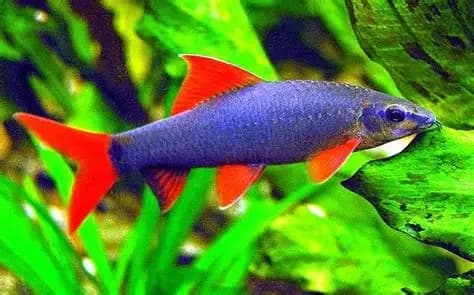
Epalzeorhynchos frenatum, the rainbow shark (or red-fin shark), is a popular Southeast Asian cyprinid with a sleek, torpedo-shaped dark body and vivid orange-red fins. Their shark-like body profile and bold fin coloration make them one of the most striking mid-sized freshwater fish for community aquariums. Their name refers to their body shape and fin arrangement, not any relation to true sharks.
Native to the Mekong, Chao Phraya, and other major river basins of Southeast Asia, rainbow sharks inhabit fast-flowing rivers and streams with rocky, sandy, or muddy substrates. They are territorial bottom dwellers that establish and defend territory vigorously.
Rainbow shark care is easy to moderate. Their territorial behavior toward other bottom-dwelling fish and similar-shaped species requires careful tank mate selection, but their hardiness, attractive appearance, and active personality make them rewarding community fish in appropriately designed setups.
Basic Overview
Common Misconceptions
"Multiple rainbow sharks can share a tank." Rainbow sharks are strongly territorial with each other and with similar-shaped fish. Two rainbow sharks in a standard aquarium will fight persistently. One per tank is the standard approach. Very large tanks (125+ gallons) with multiple separate territories may allow coexistence.
"They are safe with all bottom dwellers." Rainbow sharks are territorial toward fish occupying their bottom zone, including corydoras, large loaches, and other sharks. They are generally peaceful with mid and upper-water fish that do not compete for their territory.
"They grow to only 3-4 inches." Rainbow sharks regularly reach 5-6 inches in a well-maintained aquarium. This adult size requires a tank of at least 55 gallons.
"They are related to true sharks." Rainbow sharks are members of the carp family (Cyprinidae). The "shark" name refers only to body shape similarity. They are not related to cartilaginous sharks in any meaningful way.
Recommended Setup
- 55+ gallon tank
- Only one rainbow shark per tank
- Caves and hiding spots the shark can claim as territory
- Driftwood and rocks creating visual barriers
- Fine sand or smooth gravel substrate
- Good filtration and moderate flow
- Tank mates: tetras, rasboras, danios, barbs (mid and upper water species)
Diet
Rainbow sharks are omnivores with significant algae and plant matter in their diet:
- High-quality sinking pellets
- Algae wafers and spirulina
- Frozen bloodworms
- Frozen brine shrimp
- Blanched vegetables: zucchini, spinach
Feed once daily. Rainbow sharks are active foragers that graze on algae and biofilm throughout the day. Sinking pellets and algae wafers as the dietary foundation, supplemented with frozen protein foods several times per week, maintain excellent health and fin coloration.
Personality
Rainbow sharks are confident, assertive fish with a bold presence in any tank. Their dark body with vivid orange-red fins and their patrol of the tank bottom with fins fully spread creates a dramatic visual. They are not shy fish and quickly become the focal point of the lower tank zone.
Their territorial behavior, while requiring management through tank mate selection, is also part of their appeal. A rainbow shark establishing and defending its chosen territory, chasing away intruders from its domain while being ignored by upper-water schooling fish, illustrates the natural behavioral complexity that makes them interesting.
In a 55+ gallon community tank with appropriate tank mates, a single rainbow shark is a striking, active, long-lived centerpiece fish.
Water Parameters
Rainbow sharks come from the fast-flowing rivers of Southeast Asia:
- pH: 6.5-7.5
- Hardness (gH): 5-15 dGH
- Temperature: 75-82 degrees F
- Ammonia and Nitrite: 0 ppm
- Nitrate: below 20 ppm
Here are some top tips to deal with unwanted parameters:
- Standard community tank parameters are appropriate.
- Good filtration and moderate flow.
- Weekly 25-30% water changes maintain good conditions.
- Their adaptability to a range of parameters is a strength.