Albino Bichir Care Guide
A Complete Care Guide for Polypterus senegalus (Albino Variant)
Introduction
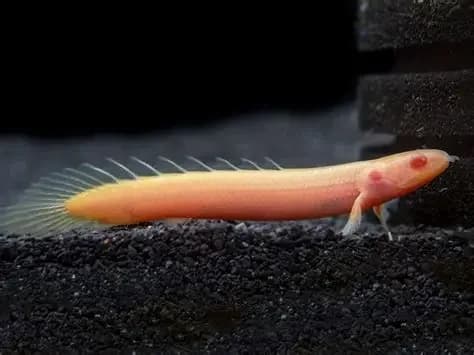
Polypterus senegalus, the Senegal bichir, is one of the most ancient-looking fish in the freshwater hobby, belonging to a lineage that has existed largely unchanged for tens of millions of years. The albino variant displays a pale cream to white body with pink-tinged fins in place of the standard grey-green coloration, giving it a ghostly, dramatic appearance. Their elongated, armored body, lobed pectoral fins, and distinctive serrated dorsal spines make them instantly recognizable.
Native to the Nile River system and tropical West and Central Africa, Senegal bichirs inhabit slow-moving rivers, swamps, and seasonal floodplains. They possess both functional gills and a modified swim bladder that acts as a lung, allowing them to breathe atmospheric air at the surface. This adaptation lets them survive in oxygen-depleted environments that would be lethal to most fish.
Albino bichir care is intermediate. They require a large tank with a secure lid, a carnivore-appropriate diet, and tank mates large enough not to be eaten. Their remarkable longevity, prehistoric appearance, and air-breathing behavior make them distinctive long-term companions.
Basic Overview
Common Misconceptions
"The albino needs different care from standard bichirs." The albino coloration is the only meaningful difference. All husbandry, dietary needs, and behavioral characteristics are identical to standard Polypterus senegalus. Albino specimens may be slightly more light-sensitive and benefit from dimmer conditions.
"They only use gills like normal fish." Bichirs must have regular access to the surface to breathe air. Their lung-like organ is functional and essential. Preventing surface access, or housing them in tanks with no air gap, is fatal over time.
"They are safe with small fish." Bichirs are ambush predators and will consume any fish that fits in their mouth, including surprisingly large prey. Tank mates must be substantially larger than the bichir's head width.
"Slow movement means they are sick." Bichirs are naturally sedentary hunters that creep along the substrate using their paddle-like pectoral fins. Extended periods of stillness, interrupted by surface dashes for air, are entirely normal behavior.
Recommended Setup
- 90+ gallon tank, wide footprint preferred over tall
- Secure, tight-fitting lid with all gaps sealed (bichirs are exceptional escape artists)
- Sand or fine gravel substrate
- Caves, PVC pipe sections, or slate overhangs for hiding
- Low to moderate lighting (albino fish are more light-sensitive)
- Good filtration; gentle flow
- Surface air gap maintained at all times
Diet
Albino bichirs are carnivores that require meaty sinking foods:
- Large sinking carnivore pellets (primary staple once trained)
- Frozen bloodworms
- Chopped frozen market shrimp
- Earthworms
- Frozen lance fish or silversides
Feed every other day in the evening. Bichirs are nocturnal hunters that locate food by scent. Drop food near their daytime resting spot. They do not compete well with active surface-feeding fish. Avoid live feeder fish due to disease transmission risk. Overfeeding a sedentary fish leads to obesity; maintain a lean feeding schedule.
Personality
Albino bichirs are slow, deliberate, and primordially graceful. They creep along the substrate using their lobed pectoral fins in a walking motion, periodically launching upward to the surface for a quick gulp of air, then settling back to the bottom. This behavior is hypnotic to observe and speaks to the ancient nature of the species.
Despite poor eyesight -- more pronounced in albino variants -- bichirs become aware of their keeper over time and associate the presence at the tank with feeding. They are not interactive in the manner of cichlids but develop a calm, observable routine.
Their 15-20 year lifespan makes them genuine long-term commitments. Bichirs that are well-maintained through their full lifespan grow into impressive, thick-bodied fish that are among the most striking large fish in the freshwater hobby.
Water Parameters
Albino bichirs are hardy and adaptable to a wide range of water conditions:
- pH: 6.5-8.0
- Hardness (gH): 5-20 dGH (highly adaptable)
- Temperature: 75-86 degrees F
- Ammonia and Nitrite: 0 ppm
- Nitrate: below 25 ppm
Here are some top tips to deal with unwanted parameters:
- Surface access for air breathing is non-negotiable. Never obstruct the entire surface.
- Bichirs are adaptable to most municipal tap water parameters. Matched dechlorination is the primary requirement.
- Weekly 25-30% water changes are standard.
- Protect filter intakes with pre-filter sponges -- young bichirs can be drawn into standard intakes.