Three Spot Gourami Care Guide
A Complete Care Guide for Trichopodus trichopterus
Introduction
Trichopodus trichopterus, the three spot gourami, is one of the most widely kept gourami species, and one of the most misunderstood in terms of temperament. Available in the wild-type blue form as well as gold, opaline (marbled), and silver varieties, they are large, hardy labyrinth fish that can display significant aggression toward other fish, particularly tank mates with long fins or similar body shape.
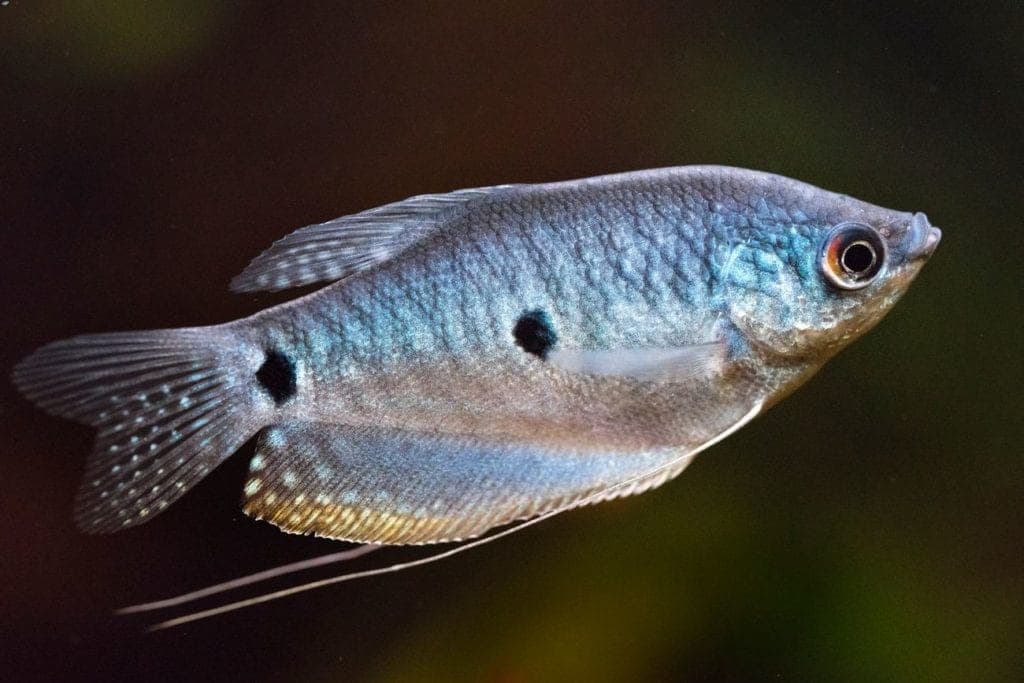
Native to Southeast Asia across Myanmar, Thailand, Malaysia, Vietnam, and Indonesia, three spot gouramis inhabit slow-moving, still, heavily vegetated waters including rice paddies and shallow lakes. They are called "three spot" because of the two black spots on their body (one at mid-flank, one at the tail base) plus their eye, which counts as the third spot.
Despite their aggression potential, three spot gouramis are hardy, long-lived, and striking fish that can anchor a community tank when paired with the right companions. Understanding their temperament is the key to success.
Basic Overview
Common Misconceptions
"Three spot gouramis are as peaceful as dwarf gouramis." They are not. Three spot gouramis are significantly more aggressive than dwarf gouramis and can injure or kill tank mates, particularly other gouramis, long-finned fish, and bettas.
"Multiple three spot gouramis can be kept together." Two males will fight persistently. A male-female pair may work in a large tank but the male often harasses the female outside of spawning. One male per tank is the simplest approach.
"Gold and opaline gouramis are different species." These are color varieties of the same species, selectively bred for different colorations. Their care requirements and temperament are identical.
"They eat significant algae." Three spot gouramis graze on some algae and biofilm, but they are not reliable algae cleaners. Their appetite for algae is secondary to their protein-based diet.
Recommended Setup
- 30+ gallon tank for a single specimen; 55+ gallons for male-female pair
- Dense planting provides visual barriers and reduces aggression
- Floating plants are especially important for this surface-oriented labyrinth fish
- Driftwood and rocks to divide visual space
- Gentle filtration; strong surface flow stresses labyrinth fish
- Tight lid with minimal gaps; labyrinth fish need humid air above the surface
- Moderate lighting; well-lit tanks with plants suit them well
Diet
Three spot gouramis are omnivores that eat insects, small invertebrates, algae, and plant matter in the wild:
- High-quality tropical flakes or small pellets as a staple
- Frozen bloodworms and brine shrimp
- Freeze-dried tubifex and krill
- Blanched vegetables: zucchini, cucumber, spinach
- Live foods for breeding conditioning: brine shrimp, mosquito larvae
Feed once or twice daily. Three spot gouramis are eager feeders that accept most foods. A varied diet with both protein and plant matter maintains best health. Overfeeding leads to obesity and fouled water; feed measured amounts.
Personality
Three spot gouramis are confident, inquisitive fish with strong personalities. They investigate everything in the tank and quickly learn to recognize their keeper. They are interactive fish that approach the glass readily and can become remarkably bold over time.
Their aggression is most pronounced toward other gouramis, bettas, and fish with long flowing fins, which they attack unpredictably. Toward other robust, fast-moving fish that present no apparent challenge, they are often tolerant.
Individual specimens vary widely in aggression. Some are relatively peaceful in community setups; others are persistent bullies that require isolation. If a three spot gourami shows aggression toward tank mates, separation is often the only reliable solution.
Compatible Tank Mates
Choosing tank mates requires avoiding long-finned, slow, or similar-colored fish. Robust, fast-moving companions that occupy the lower water column or can easily escape the gourami's attention are most successful: tiger barbs, giant danios, swordtails, larger tetras, and corydoras on the bottom.
Never keep three spot gouramis with bettas, dwarf gouramis, or other gourami species. The similarity in shape and coloration triggers intense aggression.
In a large, heavily planted 55-gallon tank, three spot gouramis can sometimes be kept in a male-female pair if there is sufficient visual cover for the female to escape occasional male harassment. Monitoring the female for signs of chronic stress (hiding, torn fins, emaciation) is essential.
Water Parameters
Three spot gouramis come from the slow-moving, warm, often still waters of Southeast Asia:
- pH: 6.0–8.0 (very adaptable)
- Hardness (gH): 5–25 dGH (very adaptable)
- Temperature: 72–82°F
- Ammonia and Nitrite: 0 ppm
- Nitrate: below 20 ppm
Here are some top tips to deal with unwanted parameters:
- Three spot gouramis are among the most water-chemistry-tolerant gouramis. Standard tap water in most areas suits them perfectly without modification.
- Weekly 25% water changes maintain adequate water quality. Their hardy constitution tolerates minor water management inconsistencies.
- No surface agitation from the filter; labyrinth fish need calm, humid air above the water surface for healthy breathing. Direct filter output downward.
- The lid must maintain warm, humid air above the waterline. Cold air above the surface causes respiratory problems in labyrinth fish, particularly in winter.