Julie Regani Cichlid Care Guide
A Complete Care Guide for Julidochromis regani
Introduction
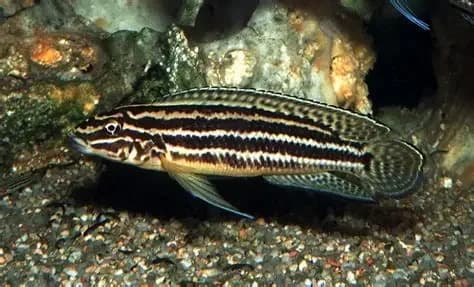
Julidochromis regani, the regani julie (or striped julie), is a Lake Tanganyika cichlid from East Africa with a distinctive elongated body and bold horizontal stripe pattern. Their cream to yellow body marked with broad dark horizontal stripes and iridescent spotting creates a striking, patterned appearance. Like all Julidochromis species, they are adapted to the rocky littoral zone of Lake Tanganyika.
Endemic to Lake Tanganyika, J. regani inhabits the rocky shores at depths of 3-10 meters, where it lives in pairs or small groups among the crevices and surfaces of the rocky reef. They are substrate-spawning cichlids with biparental care.
Julie regani care is easy to moderate for aquarists familiar with Tanganyikan cichlids. Their hard alkaline water requirements, pair-bonding behavior, and interesting parental care make them rewarding fish for dedicated Tanganyika setups.
Basic Overview
Common Misconceptions
"They are safe in soft, acidic community tanks." Julie regani are Lake Tanganyika fish requiring hard, alkaline water. Soft, acidic water causes chronic osmotic stress and disease. Hard alkaline conditions are non-negotiable.
"A single fish is fine." While hardy alone, Julidochromis species display their full behavioral range as bonded pairs. The pair bonding, spawning, and parental care behaviors that make them rewarding fish require at minimum a pair.
"Males are the only territory defenders." Both sexes in a J. regani pair defend their territory. Females can be the more aggressive territory defender against intruders, which surprises first-time Julidochromis keepers.
"Any hard water species is a compatible tank mate." Julie regani are best kept with other Lake Tanganyika species of compatible size and temperament. Shell-dwellers, Neolamprologus species, and Altolamprologus make good community companions.
Recommended Setup
- 40+ gallon tank for a pair or trio
- Rocky decor with horizontal crevices and caves
- Hard, alkaline water
- Crushed coral or aragonite substrate
- Good filtration and oxygenation
- Compatible Tanganyika tank mates
Diet
Julie regani are carnivores that accept most sinking and meaty foods:
- High-quality cichlid pellets
- Frozen brine shrimp
- Frozen mysis shrimp
- Frozen bloodworms
- Blanched vegetables (occasional)
Feed once or twice daily. Julie regani are reliable, non-fussy feeders. A varied protein-rich diet maintains good health and the best spawning condition.
Personality
Julie regani are fascinating, intelligent cichlids that develop a strong pair bond and defend their territory with coordinated commitment. Watching a bonded pair interact -- swimming together, defending their cave, and performing courtship behavior -- is one of the most rewarding experiences in Tanganyikan cichlid keeping.
Their elongated body allows them to navigate tight rock crevices that other cichlids cannot enter. They use this to their advantage in territory defense, disappearing into gaps that pursuers cannot follow.
Spawning occurs in hidden cave sites, and both parents guard eggs and fry. The appearance of free-swimming fry in the tank, being carefully shepherded by both parents among the rocks, is a particularly satisfying outcome of successfully bonded Julie regani.
Water Parameters
Julie regani require the hard, alkaline, highly oxygenated conditions of Lake Tanganyika:
- pH: 7.8-9.0
- Hardness (gH): 10-20 dGH
- Temperature: 75-82 degrees F
- Ammonia and Nitrite: 0 ppm
- Nitrate: below 20 ppm
Here are some top tips to deal with unwanted parameters:
- Hard, alkaline water is essential. Crushed coral substrate provides passive buffering.
- Good oxygenation through surface agitation.
- Weekly 25-30% water changes maintain good conditions.
- Lake Tanganyika conditions differ from Lake Malawi primarily in being even harder and more alkaline.