Diptail Pencilfish Care Guide
A Complete Care Guide for Nannostomus eques
Introduction
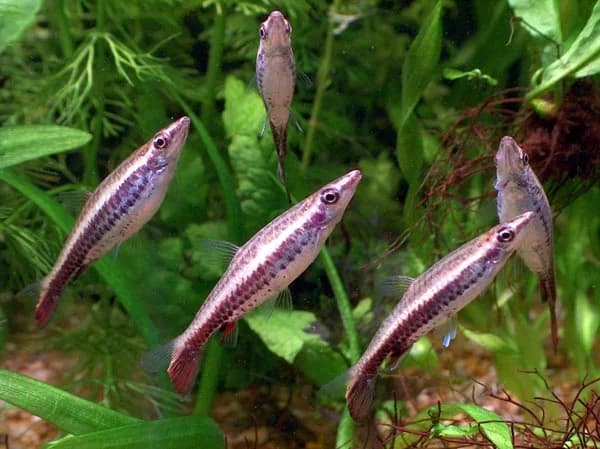
Nannostomus eques, the diptail pencilfish (also called the hockey stick pencilfish or brown pencilfish), is a distinctive small characin from the Amazon basin. Unlike most pencilfish that swim horizontally, N. eques holds its body at a characteristic 45-degree head-up angle when at rest -- a unique posture that gives it an immediately recognizable appearance. A bold brown stripe runs from the snout to the caudal fin, and a vivid red spot marks the caudal base.
Native to the Amazon River and its tributaries in Brazil, Peru, and Colombia, diptail pencilfish inhabit slow-moving, heavily vegetated, blackwater streams and flooded areas with soft, acidic, tannin-stained water.
Diptail pencilfish care is easy. Their peaceful temperament, small size, and adaptability to a range of planted tank conditions make them ideal for soft-water planted community setups. Their unusual resting posture and collective behavior in a school are particularly distinctive.
Basic Overview
Common Misconceptions
"The tilted resting angle indicates illness." The 45-degree head-up resting posture of N. eques is entirely normal and characteristic of the species. It is not a sign of swim bladder disease or any illness. A horizontal-swimming diptail pencilfish would be unusual.
"They are the same as other pencilfish." Nannostomus eques is behaviorally distinct from other pencilfish due to its unique resting posture. Its care requirements are similar but the species has a more pronounced preference for quiet, heavily planted conditions.
"A school of 4 is adequate." Groups of 10 or more produce the most natural schooling behavior and the most striking collective visual effect, with multiple fish maintaining their distinctive angled posture in loose formations.
Recommended Setup
- 15-20+ gallon planted tank
- Dense vegetation and floating plants
- Dark substrate
- Very gentle flow (slow-water species)
- Soft, acidic water
- Indian almond leaves for tannins and biofilm
- Very peaceful tank mates only
Diet
Diptail pencilfish are micro-predators requiring small foods:
- Baby brine shrimp (live or frozen)
- Micro worms
- Crushed nano flake
- Daphnia
- Grindal worms
Feed twice daily in small amounts. All food must be small enough for their tiny mouths. Live baby brine shrimp produce the best coloration and condition and stimulate natural hunting behavior.
Personality
Diptail pencilfish in a group create a distinctive display: a school of fish maintaining their characteristic angled posture, drifting through dense plant stems in slow formations, is quite unlike any other nano fish available. The collective visual is meditative and unusual.
They are utterly peaceful and compatible with dwarf shrimp, small rasboras, and nano catfish. Their slow, deliberate movement and quiet temperament suit soft-water planted setups where fast, active fish would be disruptive.
In a blackwater-style planted tank with dark substrate, driftwood, Indian almond leaves, and warm-spectrum lighting, a school of diptail pencilfish creates one of the most distinctive and peaceful nano displays available.
Water Parameters
Diptail pencilfish come from the slow, soft, acidic blackwater streams of the Amazon:
- pH: 5.5-7.0
- Hardness (gH): 1-8 dGH
- Temperature: 74-82 degrees F
- Ammonia and Nitrite: 0 ppm
- Nitrate: below 10 ppm
Here are some top tips to deal with unwanted parameters:
- Soft, slightly acidic water is important for best health and color.
- Very gentle flow. Strong current disrupts their natural slow-water behavior.
- Indian almond leaves and driftwood create the tannin-rich environment they prefer.
- Small weekly water changes (15-20%) maintain stability in nano planted setups.