Tiger Barb Care Guide
The Ultimate Care Guide for Tiger Barbs
Introduction
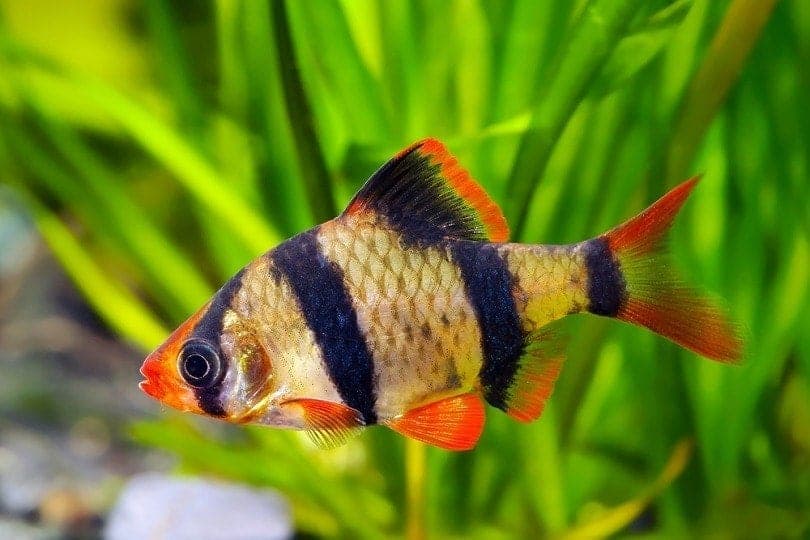
Puntigrus tetrazona, commonly known as the tiger barb, is a bold, active, and visually striking fish that is both one of the most popular and one of the most misunderstood species in the freshwater hobby. They live roughly 5-7 years in captivity and prefer temperatures of 74-79 degrees Fahrenheit. They commonly reach 2-3 inches in size, with their distinctive four black vertical bars on an orange-gold body making them immediately recognizable.
Tiger barbs have a well-earned reputation as fin nippers and semi-aggressive fish. This reputation is mostly accurate, but it comes with a crucial caveat: the aggression is dramatically reduced when they are kept in large enough groups. In groups of 10 or more, they direct most of their energy toward each other rather than at tankmates.
In the right setup, tiger barbs are energetic, gorgeous, and endlessly entertaining to watch. The key is understanding their nature and setting them up to succeed.
Basic Overview
Common Misconceptions
"Tiger barbs are too aggressive and should be avoided!" Tiger barbs are nippy and boisterous, but this behavior is largely managed by keeping them in groups of 10+. A large school directs most of its energy inward. The problem arises when they are kept in small groups of 3-5.
"A group of 5-6 tiger barbs is enough!" This is actually the most dangerous group size. Small groups of tiger barbs have no outlet for their social hierarchy behavior and redirect fin-nipping and aggression outward at tankmates. 10+ is the minimum for a well-behaved school.
"Tiger barbs will be fine with bettas and gouramis!" Tiger barbs are notorious for shredding the fins of slow-moving, long-finned fish. Bettas, gouramis, fancy guppies, and angelfish are all poor choices as tiger barb tankmates. This pairing almost always ends badly.
"All tiger barbs look the same!" Tiger barbs have been selectively bred into several color variants: the classic tiger, the green tiger barb, the albino tiger barb, and others. These can be mixed in a school and are all the same species.
Recommended Setup
- 30+ gallon tank, cycled, with a lid, heater, and filter
- Open swimming space in the center of the tank
- Live plants or decor along the back and sides for visual interest
- Moderate to strong flow (they are active fish that enjoy current)
- Fine gravel or sand substrate
- Aquarium siphon
Diet
Tiger barbs are omnivores that eagerly eat most foods offered. They are competitive, active feeders. They enjoy:
- High-quality flake food or small pellets as a staple
- Frozen or live baby brine shrimp
- Frozen or live daphnia
- Frozen bloodworms (treat)
- Blanched spinach or zucchini (some individuals accept these)
Feed small amounts once or twice daily. Tiger barbs are fast, competitive eaters. In a community tank, make sure slower or shyer fish are getting their share before the barbs eat everything.
Personality
Tiger barbs are bold, energetic fish with a lively social hierarchy. They chase each other, flash their colors, and engage in constant mild sparring within the school. This behavior looks dramatic from the outside but is completely normal and not harmful within a large enough group.
Watching a large school of tiger barbs is like watching organized chaos. They are always moving, always interacting, and their coordinated turns through the water are genuinely beautiful. The orange and black coloration flashes dynamically as they move.
Males tend to be more intensely colored than females, especially the nose, which turns bright red in healthy, active males. A group with vivid red noses and clean black bars is a sign of fish in top condition.
Compatible Tankmates
Choosing tankmates for tiger barbs requires care. The safest approach is a single-species tiger barb tank, which removes the compatibility question entirely and lets you keep the largest, most impressive school.
If a community tank is desired, the best tankmates are fast-moving fish with short fins that can hold their own: larger barbs like rosy barbs, danios, larger tetras like Congo tetras, and robust catfish like plecos or striped raphael catfish.
Strictly avoid any long-finned, slow-moving fish. Bettas, angelfish, fancy guppies, gouramis, and similar species will have their fins reduced to shreds in a tiger barb tank. This is not a pairing that occasionally goes wrong, it is one that almost always goes wrong.
Water Parameters
Tiger barbs are adaptable and tolerant of a range of water conditions, though they prefer slightly soft, acidic water. Target:
- pH: 6.5-7.5
- gH: 50-150 PPM
- Temperature: 74-79 degrees Fahrenheit
Here are some top tips to deal with unwanted parameters:
- To lower pH, use driftwood or Indian almond leaves. To raise pH gently, use crushed coral in the filter.
Tiger barbs are fairly hardy once established and tolerate moderate water parameter variations. Consistency matters more than chasing perfect numbers.
- Do weekly 20-30% water changes to keep water quality high.
- Remember, using random chemicals is not recommended, since they can cause more problems through sudden, drastic changes.