Endler's Livebearer Care Guide
The Ultimate Care Guide for Endler's Livebearers
Introduction
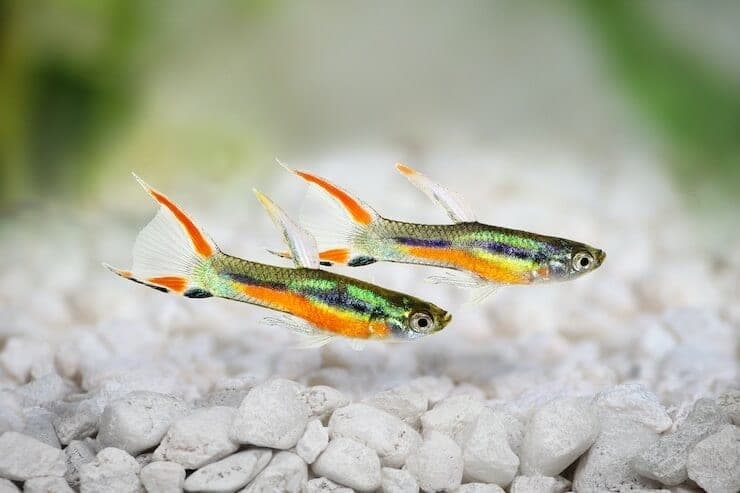
Poecilia wingei, commonly known as Endler's livebearer or simply Endlers, is a small, brilliantly colorful fish closely related to the guppy. They live roughly 2-3 years in captivity and prefer temperatures of 72-82 degrees Fahrenheit. Males commonly reach just 1-1.5 inches, making them one of the smallest livebearers in the hobby, while females reach around 1.8 inches.
Endler's livebearers are named after the scientist who rediscovered them in the wild in Venezuela in 1975. They were thought to be extinct in their natural habitat for many years and are considered endangered in the wild, though captive populations are thriving. Males display an astonishing variety of color patterns, with metallic greens, oranges, blacks, and yellows arranged in seemingly infinite combinations.
They are livebearers that breed readily and prolifically. Like guppies, females give birth to live young every few weeks. Their small size, hardiness, and spectacular male coloration make them a fantastic choice for nano tanks and planted aquariums.
Basic Overview
Common Misconceptions
"Endlers are just small guppies!" Endler's livebearers are a closely related but distinct species. Pure Endlers have a different body shape, a shorter finnage, and a distinctive color pattern compared to guppies. They also tend to be hardier and breed even more prolifically. Guppy-Endler hybrids exist and are common, but pure strains are genetically distinct.
"Endlers can be kept with guppies without any issues!" Endlers and guppies can and do interbreed, which quickly contaminates pure Endler strains. If you want to maintain pure Endlers, keep them in a species-only tank or with non-guppy tankmates.
"Endlers don't breed that much since they're so small!" Endlers breed even more prolifically than guppies relative to their size. Females give birth every 3-4 weeks, and litters in a well-fed tank can be surprisingly large. Have a plan for the fry.
"You need a big tank for any kind of fish!" Endler's livebearers are one of the few fish genuinely well-suited to small nano tanks. A 5-gallon tank can comfortably house a small colony of males, and a 10-gallon is excellent for a mixed group or species tank.
Recommended Setup
- 5-10 gallon tank, cycled, with a lid, heater, and gentle sponge filter
- Dense live plants, especially fine-leaved species like hornwort or guppy grass
- Floating plants for surface cover
- Sponge filter preferred to protect fry
- Fine substrate
- Aquarium siphon
Diet
Endler's livebearers are omnivores that eat small foods readily. Because of their tiny mouths, food size is critical. They enjoy:
- High-quality micro pellets or finely crushed flake food
- Frozen or live baby brine shrimp (an absolute favorite)
- Frozen or live daphnia
- Micro worms
- Blanched spinach finely shredded (occasional green supplement)
Feed tiny amounts once or twice daily. Their small size means very little food goes a long way. Overfeeding is a common mistake in nano tanks and quickly degrades water quality.
Personality
Endler's livebearers are active, curious, and constantly in motion. Males display almost continuously to females and to each other, showing off their vivid color patterns in an energetic courtship that is beautiful to watch. The sheer variety of color patterns in a mixed group makes them endlessly interesting.
Females are generally larger and less colorful than males but are active in their own right. In a well-planted tank, they can often be found picking at plant surfaces for algae and biofilm, much like shrimp.
A colony of Endlers in a small, densely planted nano tank is one of the most rewarding aquarium setups you can create. The combination of lush greenery and constantly darting flashes of color from the males is genuinely stunning.
Breeding
Endler's livebearers breed readily and frequently. A healthy female gives birth every 3-4 weeks, producing anywhere from 5-30 fry per litter. The fry are tiny but free-swimming from birth and immediately seek cover in dense vegetation.
Dense planting is the most effective fry protection in a community tank. Fine-leaved plants like java moss and hornwort provide ideal hiding spots. In a well-planted tank with no aggressive tankmates, a good percentage of fry will survive to adulthood naturally.
If you want to maintain a pure strain of Endlers, keep them in a species-only tank and never mix them with guppies. Hybrids are common in the trade, so sourcing fish from reputable breeders who maintain pure strains is worth the effort if purity matters to you.
Water Parameters
Endler's livebearers are adaptable and hardy, tolerating a range of water conditions. Like most livebearers, they prefer slightly alkaline, harder water. Target:
- pH: 7.0-8.0
- gH: 150-250 PPM
- Temperature: 72-82 degrees Fahrenheit
Here are some top tips to deal with unwanted parameters:
- To increase hardness and raise pH, use crushed coral in the filter. This benefits Endlers and mirrors their natural Venezuelan hard-water habitat.
- In nano tanks, water quality can degrade quickly. Do 20-30% water changes at least twice weekly to keep parameters stable.
- A sponge filter is the best choice for an Endler tank as it protects tiny fry from being sucked up.
- Remember, using random chemicals is not recommended, since they can cause more problems through sudden, drastic changes.