Algae in the Aquarium: A Complete Guide
Identifying, Understanding, and Controlling Every Major Algae Type
Introduction
Algae is the most frustrating part of the aquarium hobby for most people, and also one of the most misunderstood. It is not a sign of a dirty tank or a failure of fishkeeping. It is a natural organism, present in virtually every aquatic system, that flourishes when conditions favor it. Understanding why specific types of algae grow tells you far more about your tank's conditions than any single test kit reading.
The good news: every common aquarium algae type has a known cause and a reliable solution. Here is a guide to each one.
Quick Overview
Brown Algae (Diatoms)
Brown algae, or diatoms, is the thin brown coating that covers glass, decor, and plants in almost every new aquarium within the first few weeks. It is soft, wipes off easily, and is entirely harmless.
- Cause: high silicate levels in new tanks (from tap water and new substrate) combined with low light. Diatoms thrive before a tank fully matures.
- Solution: patience. Diatoms disappear on their own as the tank matures and silicates are depleted, typically within four to eight weeks. Otocinclus catfish and nerite snails graze on diatoms enthusiastically and speed up the process.
Green Spot Algae (GSA)
Green spot algae appears as small, hard, bright green circles on the glass and slow-growing plant leaves. It is particularly common on anubias leaves. Unlike diatoms, it is tough and does not scrape off easily.
- Cause: low phosphate levels (below 0.5 ppm) or too much light duration relative to nutrients
- Solution: increase phosphate dosing if you are running a fertilized tank. Nerite snails are the best biological solution for glass and leaves. A razor blade scraper removes it from glass.
Green Dust Algae (GDA)
Green dust algae coats the glass with a thin green film that feels slippery and wipes off easily, but regrows within days. It is particularly common in new tanks.
- Cause: excess light in an immature tank; common in new setups in the first one to two months
- Solution: counterintuitively, do not wipe it for two to three weeks. GDA has a natural die-off cycle; letting it run its course and wiping it all at once when it detaches on its own is more effective than continuously disturbing it.
Hair Algae / Thread Algae
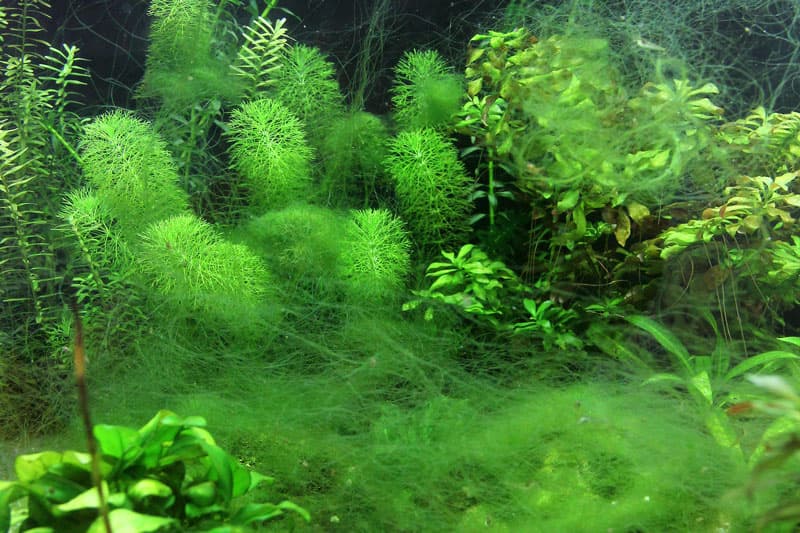
Hair algae forms long, fine, green strands that grow in tangled mats on plants, substrate, and decor. It can grow remarkably fast and is one of the most visually frustrating algae types.
- Cause: excess light combined with elevated nutrients (particularly nitrate and phosphate), often in a new tank that has not yet established nutrient balance
- Solution: reduce photoperiod to 6-7 hours; increase plant density (more plants means less nutrients available for algae); amano shrimp are voracious hair algae consumers; manual removal by twisting strands around a toothbrush
Amano shrimp (Caridina multidentata) are the single most effective biological control for hair algae and most soft green algae types. A group of 5-10 amano shrimp in a tank with a hair algae problem will often clear it within two weeks.
Black Beard Algae (BBA)
Black beard algae, sometimes called brush algae, grows in dense, dark tufts on plant leaves, hardscape edges, and filter equipment. It is one of the most stubborn algae types to eliminate and is particularly common in CO2-injected tanks.
- Cause: CO2 fluctuation is the most common cause in planted tanks; stagnant flow areas where CO2 and nutrients pool unevenly; low CO2 combined with high light
- Solution: stabilize CO2 delivery; improve flow to eliminate dead spots; spot-treat affected areas by removing decor from the tank and applying undiluted hydrogen peroxide (3%) or Excel directly to BBA and leaving for two to three minutes before returning to the tank; siamese algae eaters (SAE) are the only fish that reliably eat BBA
Blue-Green Algae (Cyanobacteria)
Despite its name, blue-green algae is not true algae at all but a photosynthetic bacteria called cyanobacteria. It forms dense, slimy sheets in vivid blue-green or dark green, covers everything rapidly, and produces a distinctive earthy or foul smell. It is the most aggressive and tank-disrupting of the common nuisance organisms.
- Cause: very low nitrate levels (below 5 ppm) combined with excess phosphate and organic waste; poor flow creating stagnant areas; low oxygen in the substrate
- Solution: manual removal, followed by a three-day blackout (cover the tank completely); after the blackout, dose erythromycin (an antibiotic available at fish stores) to eliminate remaining bacteria; improve flow and address the underlying nutrient imbalance to prevent recurrence; avoid overly low nitrate in planted tanks
If nitrate in your planted tank consistently reads 0 ppm, you may be at risk for cyanobacteria. Some nitrate (5-10 ppm) is actually healthy in a planted tank as it competes with the conditions cyanobacteria prefer.
Green Water (Algae Bloom)
Green water is a suspension of single-celled algae so dense that the water turns visibly green and you cannot see the back of the tank. It is not harmful to fish but is visually alarming and persistent if not addressed.
- Cause: excess light reaching the water column combined with elevated nutrients; common when a tank is placed in direct sunlight
- Solution: a UV sterilizer is the fastest solution and clears green water within days by killing free-floating algae cells; heavy floating plant coverage (water sprite, frogbit, duckweed) blocks light and starves the bloom; large water changes combined with reduced photoperiod
The Universal Algae Prevention Framework
Regardless of algae type, the same core principles keep algae under control: balanced lighting (8 hours or less for most tanks), adequate plant mass to compete for nutrients, consistent CO2 if running a high-light tank, regular water changes, and avoiding overfeeding. An aquarium with healthy, fast-growing plants will always be more algae-resistant than a bare or minimally planted one.
- Never run lights for more than 10 hours per day; 8 hours is a safer maximum for most tanks
- Add plants before algae appears, not after; plants are a preventive tool as much as a treatment
- Keep a clean-up crew: nerite snails, otocinclus, amano shrimp, or siamese algae eaters depending on the tank
- Address the cause, not just the symptom; removing algae manually without changing the conditions that produced it guarantees it comes back